
An egg donation cycle runs on a tight clock. Over roughly two weeks of injections, the donor’s IVF clinic needs a clear picture of how her ovaries are responding so it can adjust doses, pick the trigger night and book the retrieval. Most of that picture comes from transvaginal ultrasound scans and morning bloodwork, repeated every one to three days. When the donor lives near the clinic, that is simple. When she lives hours away, works full time or is in school, the monitoring visits become the hardest part of the cycle to organize.
This guide is for egg donor agencies, donor coordinators and donors themselves. Many surrogacy agencies also run egg donation programs, so much of the logistics will feel familiar if you already coordinate carrier monitoring. We walk through the stimulation timeline, what the baseline scan and antral follicle count show, why follicle scans happen so often, what stays at the IVF clinic (the trigger plan and the retrieval itself), and how local or mobile monitoring works in practice: referrals, getting results to the IVF clinic, and billing through escrow or the agency.
If you coordinate gestational carriers too, our guide to remote ultrasound monitoring for surrogacy agencies covers the carrier side. For the basics of how follicles are measured and what an antral follicle count means, see our follicle tracking ultrasound guide.
The egg donor cycle at a glance
Every IVF clinic has its own protocol, and the donor’s calendar comes from the clinic, not from the agency or the monitoring site. Still, most fresh donor cycles follow the same broad shape. The timing below is typical, not a promise; your clinic’s calendar always wins.
| Phase | Typical timing | Where it happens | What happens |
|---|---|---|---|
| Screening and matching | Weeks to months before the cycle | IVF clinic, genetic counselor, mental health professional, lab | Medical history, physical exam, infectious-disease testing, genetic carrier screening, psychological evaluation, pelvic ultrasound with antral follicle count |
| Cycle preparation | About 2 to 4 weeks, depending on protocol | At home | Many clinics use birth control pills or other medication to line up the donor’s cycle with the clinic’s schedule (and, in a fresh cycle, with the recipient) |
| Baseline visit | Cycle day 2 to 3, or after the preparation phase | IVF clinic or local monitoring site, plus a lab | Transvaginal scan to confirm quiet ovaries and no cysts, count antral follicles; baseline bloodwork |
| Stimulation | About 8 to 14 days, often 10 to 12 | Injections at home; monitoring every 1 to 3 days | Daily injectable medication grows a group of follicles; scans and bloodwork guide dose changes |
| Trigger | When lead follicles reach mature size, often around 18 to 20 mm | At home, at an exact time set by the clinic | A final injection (hCG or a GnRH agonist) completes egg maturation |
| Retrieval | About 34 to 36 hours after the trigger | IVF clinic only | A short procedure under sedation; the donor needs a ride home |
| Recovery | Usually 1 to 2 weeks | At home | Bloating and cramping that should steadily improve; the next period usually follows within about two weeks |
Two numbers matter most for planning: stimulation usually lasts around 10 to 12 days, and the donor typically needs a monitoring visit every one to three days during that window. Published clinic schedules range from a baseline scan plus one to four follow-up scans at some programs to visits every couple of days at others. We cover the count in detail in how many monitoring scans an egg donor needs.
Before the cycle: screening and the first ultrasound
Professional guidance shapes the screening every donor goes through. The 2024 gamete and embryo donation guidance from the American Society for Reproductive Medicine (ASRM) and the Society for Assisted Reproductive Technology (SART) recommends that oocyte donors preferably be between 21 and 34 years old, have a medical history and physical exam, complete FDA-required infectious-disease testing within a set window around retrieval, receive genetic carrier screening, and be evaluated by a licensed mental health professional with experience in third-party reproduction. It also recommends a pelvic ultrasound with an antral follicle count as part of screening, and it limits donors to six stimulated cycles.
That screening ultrasound is often the donor’s first transvaginal scan. It looks at the uterus and both ovaries, checks for cysts or other findings that could complicate stimulation, and counts the small resting follicles (antral follicles, usually 2 to 10 mm) visible in each ovary. Along with the AMH blood test, the antral follicle count helps the IVF physician predict how strongly the donor is likely to respond and choose a starting dose.
The baseline scan and antral follicle count
The baseline scan happens at the start of the treatment cycle, usually on cycle day 2 or 3 or after the preparation medications. Its job is to confirm the ovaries are quiet and ready to start. The sonographer measures the lining (normally thin at this point), looks for any leftover cyst from a previous cycle, and counts antral follicles in each ovary. Baseline bloodwork, commonly estradiol and sometimes FSH, LH and progesterone, is drawn at the IVF clinic or at a commercial lab such as Quest or Labcorp.
If a cyst is present or hormone levels are not where the clinic wants them, the start can be delayed a few days or the cycle reset. That is common and not a sign that anything is wrong with the donor; it simply means the clinic wants a clean starting point so the follicles grow together.
Follicle scans during stimulation: every one to three days
Once injections begin, monitoring visits follow a rhythm the clinic adjusts as it goes. The first check is often around day 4 to 6 of stimulation, then every one to three days as the follicles approach maturity. Visits get closer together near the end, because follicles typically grow about 1 to 2 mm a day and the trigger window is short.
At each visit the transvaginal scan records:
- The number of growing follicles in each ovary
- The size of each follicle in millimeters, usually measured in two directions and averaged
- The lining thickness and pattern (less critical for a donor, since no embryo transfer follows, but still recorded)
- Ovarian size and any free fluid in the pelvis, which can be an early clue to ovarian hyperstimulation
Bloodwork drawn the same morning usually includes estradiol, and often LH and progesterone. Rising estradiol tracks the growing follicles; an early LH rise can signal a premature surge, which the clinic prevents with additional medication. The IVF team combines the scan and the labs, then calls or messages the donor with that evening’s doses and the date of the next visit.
Because the clinic adjusts medication from every visit, timing is the single most important logistics question. Before the cycle starts, confirm how and when the IVF clinic needs monitoring information, and talk with us so scans are scheduled to fit that timeline. Morning appointments are usually best.
Trigger and retrieval stay at the IVF clinic
When enough follicles reach mature size, often when two or three lead follicles measure around 18 mm or larger, the clinic schedules the trigger shot. Many programs now use a GnRH agonist trigger for donors instead of hCG, because ASRM guidance identifies the agonist trigger as a first-line way to lower the risk of ovarian hyperstimulation syndrome, and a donor has no fresh embryo transfer that would need extra hormonal support. The trigger is given at an exact time, usually in the evening, and the retrieval is scheduled about 34 to 36 hours later.
The retrieval itself, along with any final pre-trigger scan the clinic wants to do in person, happens at the IVF clinic. It is a short procedure under sedation using a vaginal ultrasound probe and a needle, followed by about an hour of recovery. The donor needs a responsible adult to drive her home. Local monitoring replaces the travel for routine scans; it does not replace the clinic’s role in the trigger decision, the retrieval or post-procedure care.
How local or mobile monitoring works
Local monitoring means the donor’s routine scans happen near where she lives or works, and the results flow back to the IVF clinic that is managing the cycle. For donors who live far from the clinic, it can save many hours of driving across a cycle. Getting it right comes down to a handful of practical steps, ideally settled before the first injection.
- Referral from the IVF clinic. The clinic sends a referral for transvaginal follicle monitoring that lists the study, the reason, a diagnosis code, the expected cycle dates and exactly where results should go. Clinics and agencies can send referrals through our provider resources page.
- A lab order for bloodwork. Imaging centers, including ours, do not draw blood. The IVF clinic gives the donor a standing lab order so she can have estradiol and other levels drawn at a nearby Quest or Labcorp location on the morning of each scan.
- A records authorization. The donor signs an authorization for results to go to the IVF clinic. The agency typically needs only scheduling status and invoices, not clinical details, unless the donor authorizes more.
- Billing set-up. In most programs, the intended parents fund monitoring through escrow, managed by the agency or an independent escrow company. The donor should never pay out of pocket and wait for reimbursement. We can invoice the agency or escrow directly for each visit. Our guide to monitoring billing, escrow and records covers this in more depth.
- A scheduling plan with flexibility. Monitoring dates shift with the donor’s response. Agree on morning windows, a backup plan if the cycle speeds up, and who confirms each next appointment.
- Named contacts. Write down the IVF nurse or coordinator who receives results, the agency coordinator, and the clinic’s after-hours number. Everyone should know who to call if the donor has symptoms.
Who does what
| Task | Usually handled by |
|---|---|
| Protocol, doses, trigger timing, retrieval | IVF clinic |
| Referral and lab order for monitoring | IVF clinic |
| Matching, coordination, scheduling support | Agency |
| Escrow funding and invoice payment | Intended parents through the agency or escrow company |
| Transvaginal follicle scans and radiologist report | Monitoring partner (for example, our team) |
| Bloodwork | Commercial lab or the IVF clinic |
| Injections, keeping appointments, reporting symptoms | Donor |
What we offer egg donors and agencies
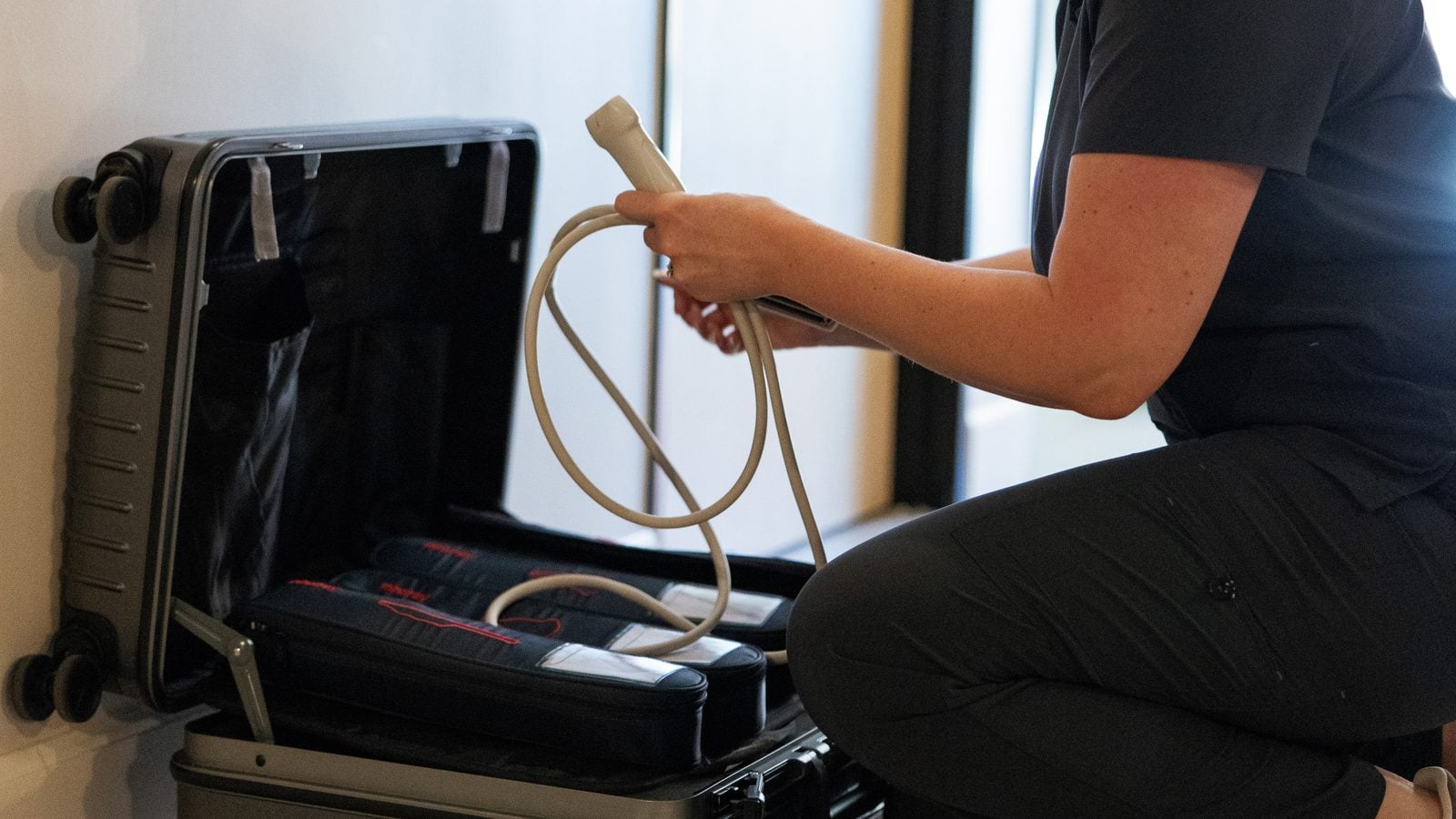
UltraVision Imaging performs transvaginal follicle monitoring at our clinic, or we bring the scan to you at home in our California service areas. A registered sonographer performs the scan with our portable ultrasound system. A board-certified radiologist reads every study, and the report is ready within 24 hours. It is sent to the IVF clinic named in the referral and to the donor. Talk with us about follicle timing before the cycle begins, so appointments line up with the clinic’s dosing calls.
- Prep: a transvaginal-only follicle scan needs an empty bladder. No fasting is needed.
- Pricing: a flat rate paid when you book, with no facility fee. HSA/FSA cards are accepted, and we can invoice the agency or escrow for each visit.
- What we do not do: we do not draw blood, give or time trigger injections, perform retrievals, or do saline sonograms. Those stay with the IVF clinic and the lab.
Donor comfort and privacy
A follicle scan usually takes about 10 to 15 minutes. The donor undresses from the waist down, with a sheet for cover, and the sonographer inserts a thin, covered and lubricated probe a short distance into the vagina. Most donors describe it as pressure rather than pain. Ovaries that are enlarged from stimulation can feel tender, so it helps to say so; the sonographer can slow down or adjust. You can ask questions or ask us to pause at any time. Our guide to what a transvaginal scan feels like has more detail.
Sonographers do not interpret results or give medical advice during the visit; the radiologist and the IVF clinic do. Our article on why the sonographer cannot tell you what they see explains why. Results belong to the donor and go to her treating clinic; anyone else, including the agency, receives clinical information only with her written permission.
Safety: ovarian hyperstimulation and other warning signs
Stimulated ovaries become larger and heavier, and a small share of donors develop ovarian hyperstimulation syndrome (OHSS), most often in the days after the trigger and retrieval. ASRM’s 2020 committee opinion on repetitive donation reports severe OHSS in about 1 to 2 percent of retrieval cycles overall and notes the rate may be lower in donors, partly because no pregnancy follows. Mild bloating and cramping are expected; worsening symptoms are not. Our full guide to OHSS warning signs for egg donors and IVF patients explains what to watch for.
Donors should call the IVF clinic promptly for weight gain of more than about 2 pounds in a day, bloating that keeps increasing, nausea or vomiting that makes it hard to keep fluids down, or noticeably less urine.
When to go to the ER or call 911
- Trouble breathing, shortness of breath or chest pain
- Severe or sudden abdominal or pelvic pain, especially on one side (a stimulated ovary can twist)
- Very little or no urine, fainting, or feeling extremely dizzy
- A painful, swollen leg, or sudden severe headache, vision changes, weakness or trouble speaking
- Heavy bleeding or fever after the retrieval
Tell emergency staff that you are an egg donor in a stimulation cycle, the date of your trigger and retrieval, and the medications you are taking. Do not wait for a scheduled monitoring visit if you have any of these symptoms.
Questions agencies should ask a monitoring partner
- Which studies do you perform, and are scans read by a board-certified radiologist?
- How soon is the report ready, and exactly how does it reach the IVF clinic?
- Can you schedule morning appointments every one to three days, and how do you handle a cycle that speeds up?
- Do you offer home visits for donors who cannot travel easily?
- Can you invoice the agency or escrow directly, with invoices limited to the minimum necessary information?
- What do you need from the IVF clinic before the first scan?
Getting your scan with us
IVF clinics and agencies can send a referral through our provider resources page, and our team contacts the donor directly to schedule. Donors with a referral in hand can also book an appointment online or call (916) 751-1944. Tell us the IVF clinic’s name, your cycle start date and whether the agency or escrow is paying, and we will help plan the visits around your calendar. For general prep tips, see how to prepare for an ultrasound.
Getting a scan with us: our pelvic and women’s health ultrasound page explains what the scan covers and how to prepare. You can book online for our clinic, or we bring the scan to you at home. A board-certified radiologist reads every study, and the report is ready within 24 hours. Your own doctor interprets the results for you.
Sources
- ASRM and SART Practice Committees. Gamete and embryo donation guidance. Fertil Steril. 2024
- ASRM Practice Committee. Repetitive oocyte donation: a committee opinion (2020)
- ASRM Practice Committee. Prevention of moderate and severe ovarian hyperstimulation syndrome: a guideline. Fertil Steril. 2024
- University of Iowa Health Care. Ovarian stimulation and monitoring
- OHSU. Steps in the fertility IVF process
- Texas Fertility Center. Egg donor cycle process
Frequently asked questions
How long does egg donor monitoring last?
Stimulation usually lasts about 8 to 14 days, most often 10 to 12. Monitoring starts with a baseline scan and then continues every one to three days until the trigger shot, with the retrieval about 34 to 36 hours later at the IVF clinic.
Can an egg donor do monitoring scans away from the IVF clinic?
Often, yes. Many IVF clinics accept outside monitoring if they send a referral, provide a lab order for bloodwork, and agree in advance how and when results reach them. The trigger decision and the retrieval stay with the IVF clinic.
Do you do the bloodwork too?
No. We do not draw blood. The IVF clinic usually gives the donor a standing lab order so estradiol and other levels can be drawn at a nearby Quest or Labcorp location on the morning of each scan.
How fast are results sent to the IVF clinic?
A board-certified radiologist reads every study and the report is ready within 24 hours. It goes to the IVF clinic named in the referral and to the donor. Talk with us before the cycle so scans are scheduled to fit the clinic’s timeline.
Who pays for egg donor monitoring?
In most programs the intended parents fund monitoring through escrow managed by the agency or an escrow company. We charge a flat rate per visit with no facility fee and can invoice the agency or escrow directly, so the donor does not pay out of pocket.
Do I need to prepare for a follicle scan?
A transvaginal-only follicle scan needs an empty bladder, so use the restroom just before. You do not need to fast. Wearing a skirt or a two-piece outfit can make the visit more comfortable.
This article is general health information, not medical advice. It does not replace a conversation with your own physician, who knows your history and can interpret results in context. If you have symptoms that worry you, contact your doctor; if you think you are having a medical emergency, call 911.