
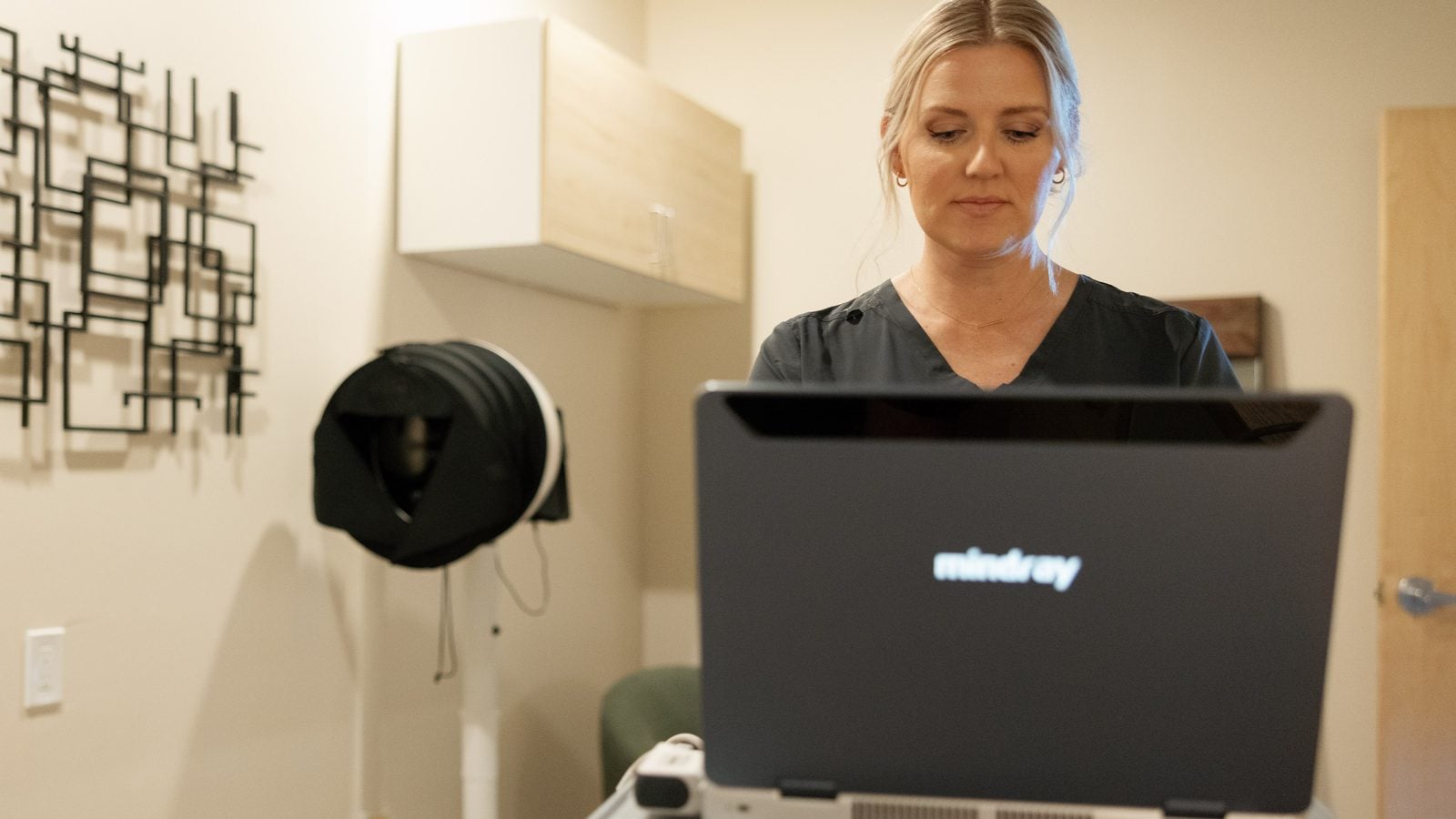
“Private ultrasound” is one of those phrases that means different things depending on who is using it. For some people it means a scan booked directly and paid for out of pocket, outside the usual hospital route. For others it means a pregnancy keepsake visit at a boutique studio. Those are very different services, and the difference matters: one produces a medical record read by a physician, and the other does not.
This guide explains what a private ultrasound usually is, how a diagnostic private scan differs from a hospital scan and from a keepsake scan, when a referral is and is not needed, how cash-pay and superbills work, and the questions worth asking any provider before you book. It also covers what a private scan cannot do, which is just as important.
One point first, because it shapes everything that follows: we never diagnose. Our sonographer performs the scan, a board-certified radiologist reads the images and writes the report, and your own physician interprets that report for you, in the context of your history, labs and symptoms. A private scan changes how you book and pay. It does not change who explains the results.
Three kinds of ultrasound people call “private”
It helps to separate three things that often get lumped together.
| Hospital or insurance-route scan | Private diagnostic scan | Elective keepsake scan | |
|---|---|---|---|
| Purpose | Medical question from your doctor | Medical question, booked directly | Bonding and keepsake images |
| Who performs it | Credentialed sonographer | Credentialed sonographer | Varies widely by business |
| Who reads it | Radiologist or other physician | Board-certified radiologist (with us) | Often no physician review |
| Written report | Yes | Yes | No |
| Usually needs a referral | Usually | Often not, with some exceptions | No |
| How it is paid | Insurance, with copay or deductible | Flat cash price, HSA/FSA | Cash |
| Replaces medical care? | It is medical care | It is medical care | No |
The middle column is what we do for most of our services. The exam is the same kind of diagnostic study a hospital performs: a credentialed sonographer follows a standard imaging protocol, and a radiologist reviews every image. What changes is the route. You book online, pay a flat rate when you book, and the report comes back to you and to the doctor you named. If you would like a side-by-side of the settings themselves, our guide to mobile ultrasound vs hospital vs imaging center goes further.
Diagnostic vs keepsake: the difference that matters most
A diagnostic ultrasound answers a medical question. Why is there pain on the right side? Is that neck lump solid or fluid-filled? How far along is this pregnancy? The sonographer captures a defined set of images and measurements, and a physician reads them and produces a written report that becomes part of your medical record.
A keepsake or elective scan has a different goal. It exists for bonding and for pictures, usually in pregnancy. The U.S. Food and Drug Administration has said that using ultrasound solely for non-medical purposes, such as obtaining fetal “keepsake” videos, has been discouraged, and that ultrasound is generally considered safe when used prudently by appropriately trained health care providers. The American Institute of Ultrasound in Medicine (AIUM) describes freestanding commercial fetal imaging sites that operate “usually without any physician review of acquired images” and encourages patients to confirm that practitioners have formal fetal imaging training.
We offer one elective pregnancy visit, our heartbeat & gender visit. We describe it plainly: it is a keepsake visit, it is non-diagnostic, it does not come with a radiologist report, and it does not replace the scans your OB or midwife orders. If the goal is medical information, the diagnostic first-trimester scan is the right booking, and it does include a radiologist report. Our post on the elective heartbeat and gender scan covers the difference in detail, and your prenatal care provider can tell you which scans your pregnancy needs.
Who reads the images, and why it matters
Ultrasound is operator-dependent. The sonographer’s skill determines what is captured, but the sonographer does not make the medical interpretation. RadiologyInfo, the patient site of the American College of Radiology and the Radiological Society of North America, describes the radiologist as the doctor trained to supervise and interpret radiology exams, who analyzes the images and sends a report.
With us, a board-certified radiologist reads every diagnostic study, and the report is ready within 24 hours. It goes to you and to the doctor you named when you booked. That is also why the sonographer does not give results at the visit; our post on why the sonographer won’t tell you what they see explains the reasoning.
The report itself is written for physicians. It may use terms that sound alarming or reassuring out of context. Your doctor is the right person to put any finding in context with your history, labs and symptoms, and to decide whether anything else is needed. If you want help understanding the general layout of a report before that conversation, see what does my ultrasound report mean, and bring your questions to your physician.
Do you need a referral for a private ultrasound?
Referral rules vary by state, by provider and by the specific test, so the only reliable answer is the one your chosen provider gives you. In many cash-pay settings in California, patients can book a number of diagnostic ultrasounds directly. That is how most of our services work: you book online, no referral needed, and the booking form asks for the name of the doctor who should receive the report. If you do not have one, type “None” and you will still receive the report yourself. There is also an optional referral upload if your doctor has given you one.
Two of our services do require a referral:
- DVT studies (leg or arm veins, checking for a blood clot). A referral is required.
- The second-trimester anatomy scan (19 to 24 weeks). A referral is required.
For both, you book online like any other scan and upload the referral in the booking form. We confirm it before the visit. Referrals are accepted through the booking form upload only. Our article do you need a referral for an ultrasound walks through this in more detail.
Even when no referral is required, it is worth talking with your doctor before booking. They can tell you which scan fits the question, whether ultrasound is the right test at all, and what they plan to do with the result.
Cash-pay basics: flat rates, HSA/FSA and superbills
Insurance-route imaging often involves a deductible, a copay, a separate facility fee and, sometimes, a separate bill from the radiologist that arrives weeks later. A cash-pay model works differently. With us, you pay a flat rate when you book. There is no facility fee, and HSA and FSA cards are accepted. Our pages on using an HSA or FSA for an ultrasound and using FSA funds before year end cover the details.
We do not bill insurance. A superbill is available on request. A superbill is an itemized receipt with the codes and details an insurer typically asks for, so you can submit it yourself if your plan offers out-of-network reimbursement. Whether your plan pays anything back, and how much, depends entirely on your plan. Our post what is a superbill explains the process step by step.
Federal rules also give self-pay patients some protections. Under the No Surprises Act, the Centers for Medicare & Medicaid Services (CMS) explains that uninsured or self-pay patients can, in most cases, get a good faith estimate of what their care will cost before they receive it. If you are comparing providers, a clear, all-in price up front is a good sign.
Questions to ask any private ultrasound provider
Whether you book with us or anyone else, these questions separate a diagnostic service from a keepsake one, and a thorough provider from a quick one.
- Is the sonographer credentialed? Ask whether the person scanning holds a credential from the American Registry for Diagnostic Medical Sonography (ARDMS), such as RDMS (with specialties such as abdomen, breast and OB/GYN) or RVT for vascular work, or a vascular credential from Cardiovascular Credentialing International (CCI). ARDMS notes that certification is voluntary and requires passing a rigorous examination, and certification status can be checked through its verification directory.
- Does a physician read every study? Ask specifically whether a board-certified radiologist reviews the images and writes a signed report. If the answer is “no report” or “we tell you at the visit”, it is not a diagnostic service.
- How long does the report take? Ask for a real turnaround time. Ours is within 24 hours.
- Where does the report go? Ask whether it goes to you, to your doctor, or both, and how. A report that never reaches the doctor who will act on it is of limited use.
- What equipment is used? A diagnostic study needs a diagnostic ultrasound system with the right transducers for the exam. Home visits should use a portable diagnostic system, not a consumer or keepsake device.
- What is included in the price? Ask whether the price covers the scan, the radiologist read and the report, and whether there is a facility fee or any travel fee.
- What prep is needed? A careful provider will give you specific instructions, because prep affects image quality.
- What happens if something urgent is seen? Ask how the radiologist communicates urgent findings and to whom.
That last question matters more than people expect. American College of Radiology guidance on communicating imaging findings says urgent or unexpected significant findings should be communicated promptly, usually to the referring or named provider, and it encourages radiologists to ask self-referred patients to identify a licensed provider who will receive results and oversee follow-up. That is one reason we ask for your doctor’s name when you book.
What a private scan can’t do
A private diagnostic scan is a useful tool, but it has clear limits.
- It is not emergency care. We schedule appointments. We cannot see someone urgently, give treatment or arrange admission. Anything that feels like an emergency belongs in an emergency department.
- It does not interpret your result for you. The radiologist describes what the images show. Your own doctor decides what it means for you and what, if anything, comes next.
- It is not every test. Ultrasound does not see well through air or bone, as RadiologyInfo notes, so some questions need CT, MRI, blood tests or a specialist exam instead. Your physician can tell you which test fits.
- It is not a substitute for prenatal care. In pregnancy, your OB or midwife decides which scans you need and when. A keepsake visit never replaces those.
- We don’t do everything. We do not draw blood, perform biopsies or injections, or offer saline sonograms, NT or genetic screening. Ask your doctor where to get those if you need them.
Services we offer as private diagnostic scans
All of these are diagnostic studies with a board-certified radiologist report, unless noted. You can see full details on our services page.
| Area | Scans |
|---|---|
| Abdomen and kidneys | Complete abdominal (liver, gallbladder, kidneys, pancreas, spleen and aorta), limited abdominal (one area), renal (kidneys and bladder) |
| Thyroid | Thyroid ultrasound |
| Vascular | Carotid duplex with CIMT, AAA screening, DVT leg or arm veins (referral required) |
| Women’s health | Pelvic with transvaginal, pelvic transabdominal only, breast (one or both sides), follicular monitoring |
| Men’s health | Scrotal, prostate (scanned over the belly) |
| Other | Soft tissue (a lump, bump or swelling) |
| Pregnancy | First trimester (6 to 13 weeks), growth scan, anatomy scan 19 to 24 weeks (referral required), and the elective heartbeat & gender visit (non-diagnostic, no report) |
Preparation depends on the scan. Abdominal and AAA studies need nothing to eat for 8 hours, though water and regular medications are fine. Kidney, prostate, transabdominal pelvic and first-trimester scans need a full bladder: 32 oz of water finished an hour before, without emptying. Thyroid needs no prep beyond an open neckline. Our guide on how to prepare for an ultrasound lists every scan.
When to skip the booking and go to the ER or call 911
A scheduled private scan is the wrong choice for symptoms that could be an emergency. Call 911 or go to the nearest emergency department for:
- Chest pain, chest pressure or sudden shortness of breath, especially with a swollen, painful leg
- Signs of a stroke: face drooping, arm or leg weakness, trouble speaking, sudden vision loss or sudden loss of balance
- Sudden, severe or tearing pain in the abdomen or back
- Severe abdominal pain with fever, vomiting or a rigid belly
- In pregnancy: heavy bleeding, severe one-sided pelvic or shoulder-tip pain, fainting or dizziness
- Sudden severe pain and swelling in the testicle
- Rapid swelling in the neck or any trouble breathing or swallowing
If you are not sure whether something is urgent, call your doctor or a nurse line, or seek emergency care. It is always reasonable to err on the side of being seen.
Getting your scan with us
Booking takes a few minutes on our booking page. Choose your scan, choose a clinic visit at our clinic or a home visit where we bring the scan to you across our California service areas, and pick a time. You pay the flat rate when you book; there is no facility fee and HSA/FSA is accepted. The form asks for the doctor who should receive the report (“None” is accepted) and offers an optional referral upload; for DVT and anatomy scans, the referral upload is required.
On the day, our sonographer performs the scan and does not give results at the visit. A board-certified radiologist reads the study, and the report is ready within 24 hours, sent to you and to your named doctor. Then the most important step: review the report with your own physician, who can explain what it means for you. If you are curious what a home visit looks like, see what happens at a home ultrasound visit.
Sources
- U.S. Food and Drug Administration: Ultrasound imaging
- AIUM: Prudent Use and Safety of Diagnostic Ultrasound in Pregnancy
- RadiologyInfo.org (ACR and RSNA): General ultrasound
- ARDMS: Information for the public
- Inteleos (ARDMS): Verify certification
- Cardiovascular Credentialing International: Registered Vascular Specialist
- American College of Radiology: Practice parameter for communication of diagnostic imaging findings
- CMS: No Surprises, understand your rights against surprise medical bills
Frequently asked questions
Is a private ultrasound the same as a keepsake scan?
Not necessarily. A private diagnostic ultrasound is a medical exam booked directly and paid for out of pocket, with images read by a physician and a written report. A keepsake scan is for bonding and pictures, usually has no physician review and no report, and does not replace medical care. Ask any provider which one they are offering.
Who reads a private diagnostic ultrasound?
With us, a board-certified radiologist reads every diagnostic study and writes the report, which is ready within 24 hours and goes to you and the doctor you named. The sonographer performs the scan but does not give results at the visit, and your own physician interprets the report for you.
Do I need a referral for a private ultrasound?
For most of our scans, no referral is needed. DVT vein studies and the second-trimester anatomy scan require one, which you upload in the booking form; we confirm it before the visit. The form also asks for the doctor who should receive the report, and None is accepted. Rules vary between providers, so always ask.
Can I use insurance for a private ultrasound?
We do not bill insurance. You pay a flat rate when you book, with no facility fee, and HSA and FSA cards are accepted. A superbill is available so you can submit a claim yourself if your plan offers out-of-network reimbursement; whether it pays anything back depends on your plan.
Is the elective heartbeat and gender visit diagnostic?
No. It is a keepsake visit. It is non-diagnostic, has no radiologist report and does not replace the scans your OB or midwife orders. If you want a medical check of an early pregnancy, the diagnostic first-trimester scan includes a radiologist report.
Can a private ultrasound be used in an emergency?
No. A private scan is a scheduled appointment, not emergency care. For chest pain, trouble breathing, stroke signs, sudden severe abdominal or back pain, or heavy bleeding or severe pain in pregnancy, call 911 or go to the nearest emergency department.
This article is general health information, not medical advice. It does not replace a conversation with your own physician, who knows your history and can interpret results in context. If you have symptoms that worry you, contact your doctor; if you think you are having a medical emergency, call 911.