
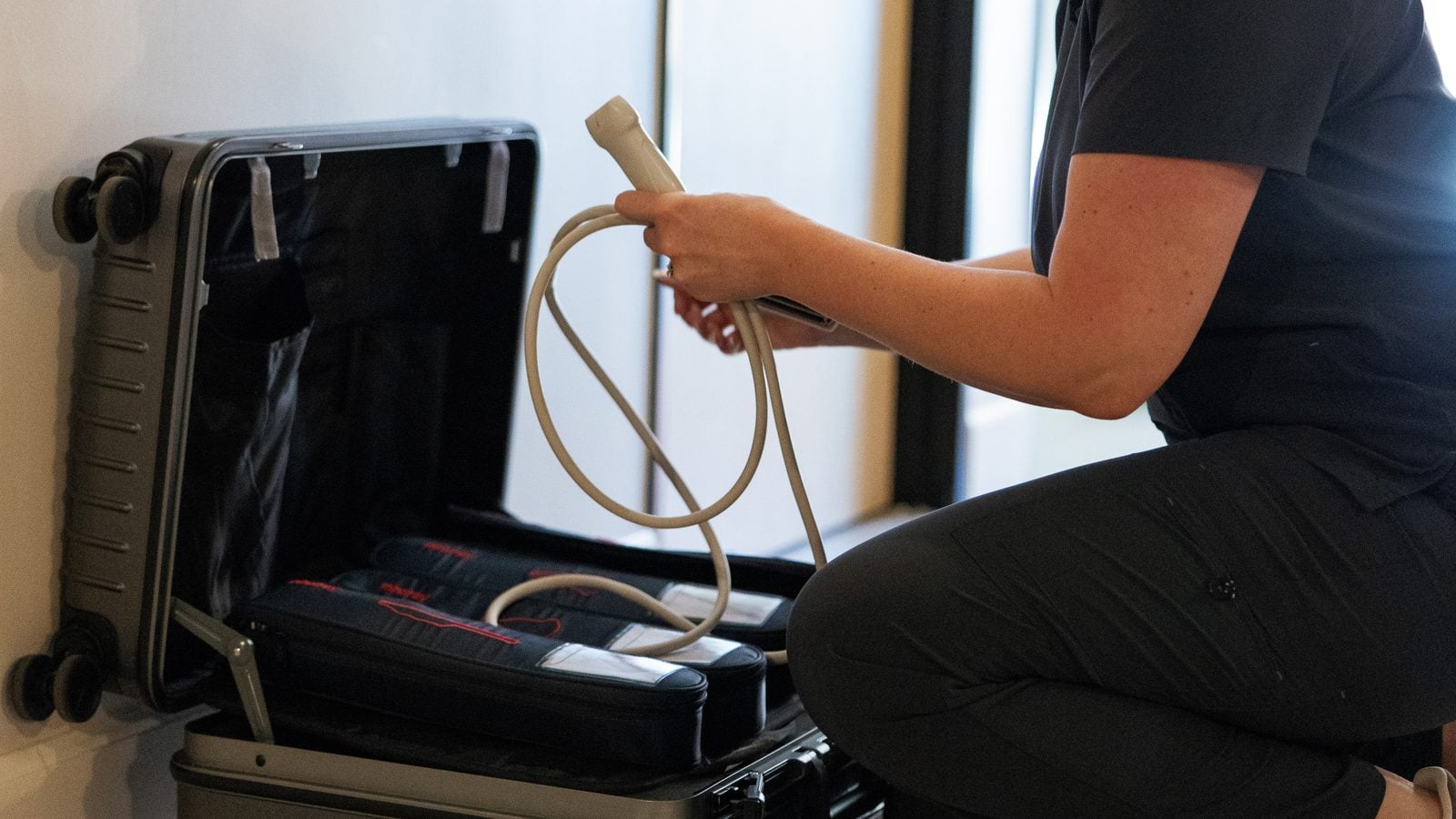
Concierge members pay for access. When one of them needs an ultrasound, the usual answer, a referral to a hospital imaging department with a two-week wait, undercuts the reason they joined. More practices now want imaging to happen the way their visits do: at the patient’s home, hotel or office, on a timeline the physician controls, with a report that comes back to the physician first.
There are three realistic ways to get there. A practice can buy a portable system and scan in-house, hire or contract a sonographer and run its own imaging service, or order formal studies from a mobile diagnostic ultrasound provider. Each works. They differ in cost, liability, staffing and how much of the physician’s time they consume. This guide lays out the trade-offs so you can choose the model that fits your panel.
Option 1: Buy a handheld or portable system and scan yourself
Handheld point-of-care ultrasound (POCUS) devices have become small and affordable enough that many internists and family physicians carry one. For focused bedside questions, such as a distended bladder, a pericardial effusion, B-lines in a short-of-breath patient, or guidance for a procedure, they are excellent tools in trained hands.
The limits are about what POCUS is, not the device. A focused bedside exam answers a yes-or-no question at the point of care. It is not a complete diagnostic study with a standardized protocol, archived images and a formal report from a radiologist. If you want to document a thyroid nodule for follow-up, characterize a renal lesion, or rule out deep vein thrombosis across the full venous protocol, you need the formal study.
Doing formal studies yourself means taking on several commitments:
- Training and credentialing. Professional societies publish training pathways and practice parameters for each exam type. Diagnostic competence in vascular, thyroid or pelvic imaging takes structured training and a meaningful volume of supervised scans.
- Image storage and reporting. Diagnostic images need to be archived and retrievable, and the interpretation needs to be documented in a way that supports follow-up and peer review.
- Malpractice exposure. If you interpret the study, you own the interpretation. Many carriers ask specific questions about in-office imaging.
- Physician time. A complete abdominal or venous study takes 30 to 60 minutes of scanning. For most concierge physicians, that is time taken from visits.
Option 2: Employ or contract your own sonographer
Some larger practices hire a registered sonographer and buy a cart-based or high-end portable system. The sonographer performs studies; a radiologist group under contract reads them. This gives the practice full control over scheduling and branding.
It also turns the practice into an imaging operation. You are responsible for the sonographer’s salary or contract whether or not there are studies to do that week, for equipment service and probe replacement, for a reading agreement, for quality review and for the logistics of moving a sonographer and equipment around a metro area. That math works when imaging volume is steady and high. For a practice that orders a handful of studies a month, the fixed cost usually outweighs the convenience.
Option 3: Order formal studies from a mobile diagnostic ultrasound provider
The third model treats imaging the way most practices already treat lab draws: the physician orders, a specialized service performs the work at the patient’s location, and the result comes back to the physician. A mobile ultrasound provider brings a diagnostic-grade portable system and an ARDMS-registered sonographer to the patient, follows a standard protocol for the study, and sends the images to a board-certified radiologist who issues a written report to the ordering physician.
For the practice, the fixed cost is zero. You pay per study, typically invoiced to the practice, and you decide whether to include imaging in a membership tier, pass it through, or bill it separately. The physician stays in charge of the clinical relationship: the practice orders, the practice receives the report, and the practice tells the patient what it means.
Questions that decide which model fits
- How many formal studies do you order per month? Fewer than about ten usually favors ordering per study. A steady volume across many exam types may justify your own staff.
- Which exams matter most? Venous duplex for suspected DVT, abdominal, renal, thyroid, pelvic and carotid studies make up most concierge requests. Confirm that any provider covers all of them, with a radiologist read for each.
- Where are your patients? Members spread across a metro area, or traveling members staying in hotels, favor a service that already handles routing and access.
- How fast do you need it? Ask how a provider handles scheduled, priority and same-day requests, and be clear that a same-day visit and a same-day radiologist report are different promises.
- Who talks to the patient? Many practices prefer that the imaging team never discusses findings with the patient. Make sure the provider’s workflow supports that.
What a good ordering workflow looks like
Whatever model you choose, the workflow that keeps concierge patients happy is the same. The physician or office submits an order with the patient’s name, mobile number, location, the exam requested and the clinical question. The imaging team confirms timing with the office or the patient, depending on the practice’s preference. The study is performed at the location, typically in 30 to 45 minutes. The radiologist report goes to the ordering physician, usually within 24 hours, and the practice receives one invoice.
Two details separate a smooth program from a frustrating one. The first is a clear plan for urgent findings: who calls whom, and how fast, if the radiologist sees something that cannot wait for the written report. The second is a clean handoff of access information for gated homes, hotels and offices, so the sonographer is not standing in a lobby while the patient waits.
Making imaging part of the membership experience
However a practice provides imaging, members judge it by the experience. The details that matter most are the same ones that make concierge medicine work: a single point of contact, a clear time window, a professional who explains what is happening, and an answer that comes from the physician who knows the patient. Practices that brief members in advance, so they know who is coming, how long it takes and when they will hear results, report fewer anxious calls and better feedback.
Starting small
Practices new to mobile imaging often start with one or two common studies, such as venous duplex for leg swelling and abdominal ultrasound for right upper quadrant pain, then expand once the workflow is familiar. After a few orders, the office knows exactly what information to include and how long the process takes, and the physician can decide whether imaging volume justifies a different model.
Where UltraVision fits
UltraVision Imaging is a mobile diagnostic ultrasound service built for the third model. Our ARDMS-registered sonographer performs the study at your patient’s home, hotel or office, a board-certified radiologist reads it, the report goes to the ordering physician, and your practice receives one invoice. We serve concierge, house-call and private-medicine practices across San Diego County, Los Angeles, Orange County and Palm Springs, the Bay Area and the Sacramento region. You can see every region and its local line on our page for physicians, or send a referral from any area page. Our team will be in touch to coordinate scheduling.
Frequently asked questions
Is a handheld POCUS device enough for a concierge practice?
For focused bedside questions, often yes. For a complete diagnostic study with archived images and a formal radiologist report, such as a full venous duplex, thyroid or abdominal exam, most practices order a formal study.
Do we need our own radiologist contract to order mobile ultrasound?
Not when you order from a mobile diagnostic provider. The provider arranges the radiologist read and sends the report to the ordering physician.
Who bills the patient?
That is the practice’s choice. Mobile studies are usually invoiced to the practice, which can include imaging in a membership, pass the cost through, or bill separately. Review the arrangement with your own advisors.
Will the sonographer discuss results with my patient?
Sonographers do not interpret images or discuss findings. The radiologist report goes to the ordering physician, who explains it to the patient.
How long does a mobile study take on site?
Most single-area studies take 30 to 45 minutes of scanning; complete abdominal, venous and multi-area studies take longer.
Can a mobile provider handle patients staying in hotels?
Yes. Hotel visits are common for traveling members. The office or the patient arranges room access and building check-in ahead of time.
Sources
- ACEP: Ultrasound Guidelines: Emergency, Point-of-Care, and Clinical Ultrasound Guidelines in Medicine
- AIUM: Practice parameters for ultrasound examinations
- ARDMS: About sonographer credentials
- Baker Donelson: State of Concierge and Consumer Medicine 2026
- FDA: Ultrasound imaging
This article is general information for licensed clinicians and practice staff. It is not medical or legal advice and does not replace clinical judgment. UltraVision Imaging performs diagnostic ultrasound; a board-certified radiologist interprets every diagnostic study, and the ordering physician directs care.