
Many people want their health care handled quietly. Some simply value their time and dislike waiting rooms. Some are dealing with something sensitive and would rather not explain it to anyone except their doctor. Others are public-facing, or care for family members who should not have to know every detail. Wanting privacy around a medical test is reasonable, and it is worth understanding exactly what a private imaging visit does and does not involve.
This guide describes, factually, what to expect from an ultrasound at home or at our clinic: the setting, who is in the room, what the booking form asks for and why, where the report goes, how you can share it or keep it to yourself, and the basic privacy rights that federal law gives every patient. It does not promise anything beyond that. Every patient is treated under the same process and the same privacy rules, however they book.
The roles stay the same in every setting, so it is worth saying plainly: we never diagnose. Our sonographer performs the scan. A board-certified radiologist reads the images and writes the report. Your own physician interprets that report for you, in the context of your history, labs and symptoms.
What “private” can and can’t mean
In imaging, “private” usually describes three things: the setting (where the scan happens and who else is around), the people involved (who is in the room and who sees your information), and the information itself (where your report and records go). A private visit can make the setting more comfortable and keep your information moving only where it needs to go. It cannot change the medicine. The scan is the same diagnostic exam, the radiologist read is the same, and the report timing is the same for every patient.
| Privacy factor | What to know | A question worth asking any provider |
|---|---|---|
| Setting | At home there is no waiting room; at a clinic the scan takes place in an exam room | Where exactly will the scan happen, and who else will be nearby? |
| Who is present | You decide whether anyone joins you | Can I bring someone, or come alone? |
| Information collected | Only what is needed to book, scan and deliver the report | Why do you need each piece of information you ask for? |
| Report delivery | The report goes to you and to the doctor you name | Who receives the report, and can I choose not to name a doctor? |
| Your legal rights | HIPAA gives patients rights over their health information | Where is your Notice of Privacy Practices? |
| Payment records | We do not bill insurance; a superbill is available if you want one | Will anything be sent to my insurer without my asking? |
The setting: at home or at our clinic
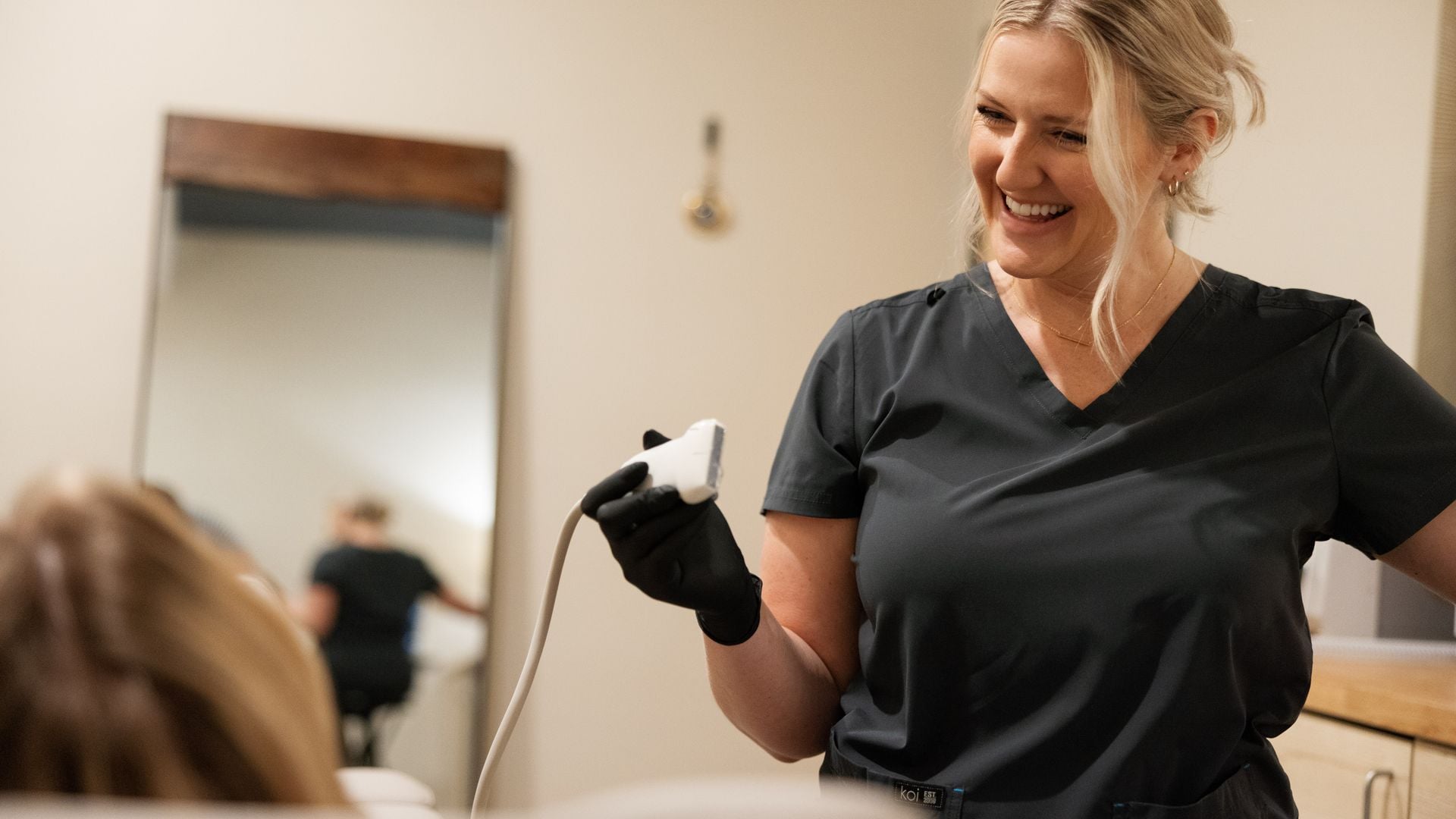
For a home visit, we bring the scan to you across our California service areas. Our sonographer arrives with a portable diagnostic ultrasound system, sets up in a room you choose, performs the scan and packs everything away afterward. There is no waiting room, no check-in desk and no other patients. You choose the room, and you can close the door. Our post What happens at a home ultrasound visit walks through the visit in order.
If you prefer not to have a scan at home, perhaps because you share your home with people you would rather not involve, you can book a visit at our clinic instead. The scan, the radiologist read and the report are the same in both settings. If you are comparing settings more broadly, mobile ultrasound vs hospital vs imaging center sets out the differences.
Who is in the room
You decide whether anyone else is present. Some people like to have a partner, friend or family member nearby; others prefer to be alone with the sonographer. Either is fine. At a home visit, it is also reasonable to ask other members of the household to give you some space for the length of the scan.
For pelvic scans, the transvaginal part is always your choice, and you can ask to stop at any time. A transabdominal-only pelvic ultrasound, scanned over the lower belly, is an option when an internal scan is not wanted, and it is the only pelvic approach we use for anyone under 18. The sonographer will explain each step before it happens. Our post Transabdominal vs transvaginal pelvic ultrasound explains the difference, and your doctor can tell you which approach suits the question they are trying to answer.
What the booking form asks for, and why
People who care about privacy often want to know why each question on a form is there. Here is what our online booking asks for, and the reason behind each item.
- Your ZIP code. This shows the times and pricing available for your location, including whether a home visit is available where you are.
- The scan and the time. So the right sonographer, equipment and appointment length are set aside.
- Your contact details, and your address for a home visit. So we can confirm the visit, arrive at the right place and deliver your report to you.
- The doctor who should receive the report. So the report reaches a physician who can interpret it and act on it. If you do not have one, or prefer not to name one, type “None”; you will still receive the report yourself.
- An optional referral upload. Most scans do not need a referral. DVT (vein clot) studies and the second-trimester anatomy scan do, and the referral is uploaded in the booking form, which we confirm before the visit. Please do not text, email or photograph a referral to us; the form is the only route.
- Payment. A flat rate is paid when you book. There is no facility fee, and HSA and FSA cards are accepted.
Our Notice of Privacy Practices, Privacy Policy and Terms of Service are linked from our booking page. If you have a question about how your information is used, it is reasonable to ask before you book.
HIPAA basics: the rights every patient has
The HIPAA Privacy Rule is the federal law that governs how health care providers and health plans handle health information. According to the U.S. Department of Health and Human Services (HHS), it applies to every health care provider, regardless of size, that electronically transmits health information in connection with certain transactions. HHS summarizes several rights that matter to privacy-minded patients:
- Notice. Covered providers must give you a notice describing how they may use and disclose your health information.
- Access. You have a right to see and get a copy of your health information. HHS says a provider normally has up to 30 days to respond, that in most cases you can get it in the form you want, such as by email, and that you can ask for it to be sent directly to someone else, such as a family member or caregiver.
- Confidential communications. Providers must allow you to ask to receive communications by an alternative means or at an alternative location, for example a different phone number or address.
- Requesting restrictions. You can ask a provider to limit certain uses or disclosures. HHS notes the provider is not required to agree to every request.
- Minimum necessary. Covered entities must make reasonable efforts to use, disclose and request only the minimum health information needed for a purpose.
- Accounting of disclosures. You have a right to an accounting of certain disclosures of your information, covering the six years before your request.
This is a general summary from HHS materials, not legal advice. The rules have exceptions, and the HHS pages linked in the sources below explain them in full.
Results: who reads the scan and when the report is ready
Our sonographer does not give results during the visit. That can feel frustrating when you are lying there watching the screen, but it is how diagnostic imaging works: the radiologist needs to review the complete set of images, and a quick comment from the sonographer could easily be incomplete or misleading. Our post Why won’t the sonographer tell me what they see? explains this in more detail.
A board-certified radiologist reads every diagnostic study, and the report is ready within 24 hours. It goes to you and to the doctor you named on the booking form. The report is a medical document written for a physician, and only your own doctor can explain what it means for you. Our guide What does my ultrasound report mean? explains how reports are laid out, in general terms, so you can come to that conversation with good questions.
One exception to keep in mind: the elective heartbeat and gender visit is a keepsake visit, not a diagnostic study. It has no radiologist report and does not replace the scans your OB or midwife arranges.
Sharing your report, or keeping it to yourself
You have more control over where your report goes than many people realize. A few practical points:
- You choose the doctor. The report goes to the doctor you name, which might be your primary care doctor, a specialist, or a concierge physician. Naming a doctor is strongly recommended, because a report is most useful in the hands of someone who can interpret it and act on it.
- You can share it yourself. Once you have your report, you can pass it to any other doctor you see, or bring it to an appointment.
- Family members. A spouse, adult child or other relative does not automatically receive your report. HHS explains that you can direct a provider in writing, with your signature, to send your information to a family member. If you want someone else to have access, ask us how to set that up.
- Insurance. We do not bill insurance. If you want to seek reimbursement, a superbill is available and you decide whether to submit it to your plan. See What is a superbill? for how that works.
If you are weighing whether to name a doctor at all, talk it through with a physician you trust. Having a scan without anyone to interpret the result can leave you with a document full of technical language and no clear next step.
Following up by telehealth with your own doctor
Many people review imaging results with their doctor by video or phone. That can be both convenient and private, provided the call itself is private. HHS offers telehealth privacy tips for patients, including:
- Have the appointment in a private location, or use headphones and keep your screen out of view.
- Turn off nearby voice assistants and smart speakers that could overhear the conversation.
- Use your own device and network rather than a work-issued device or public Wi-Fi.
- Turn on multi-factor authentication where it is available, and keep your software up to date.
- If a telehealth link looks suspicious, check with your provider before opening it.
Useful questions for that conversation include: What does the impression section mean in my case? Does anything on the report need follow-up, and how soon? Should this be compared with earlier imaging? Is there anything I should watch for in the meantime? Your physician will put the report in context with your history, labs and symptoms.
What a private visit does not include
To keep expectations accurate, here is what a private ultrasound with us is not:
- It is not emergency care, and it is not a substitute for being seen urgently.
- It does not include results or interpretation at the visit. The radiologist writes the report, and your doctor interprets it.
- It does not include biopsies, injections, saline sonograms, blood draws, 3D or 4D keepsake sessions, or NT and genetic screening. Bloodwork is done at labs such as Quest or Labcorp.
- It does not come with a different standard of care. Every patient gets the same diagnostic scan, the same radiologist read and the same report timing.
When to go to the ER or call 911
Privacy should never delay urgent care. Do not wait for a scheduled scan if you have any of the following. Call 911 or go to the nearest emergency department:
- Chest pain, or sudden shortness of breath, particularly with a swollen or painful leg.
- Stroke signs (BE FAST): loss of balance, vision changes, a drooping face, arm or leg weakness, slurred speech, and time to call 911.
- Sudden, severe abdominal, pelvic or back pain.
- Heavy vaginal bleeding, or bleeding or severe pain in pregnancy.
- Sudden, severe testicular pain.
- Trouble breathing or swallowing, or rapid swelling of the neck.
Hospitals are generally covered by the same federal privacy rules as other health care providers. If something feels wrong but not like an emergency, call your own doctor and ask how soon you should be seen.
Getting your scan with us
Book online on our booking page. Enter your ZIP code to see available times for your location, choose the scan your doctor named and a time that suits you, and choose a home visit or our clinic. Name the doctor who should receive the report, or type “None”. Upload a referral in the form if you have one; DVT studies and the anatomy scan require it. Payment is a flat rate taken when you book, with no facility fee, and HSA and FSA cards are accepted. Check our guide on how to prepare for an ultrasound for the prep your scan needs. A board-certified radiologist reads your study, and the report is ready within 24 hours for you and the doctor you named.
Sources
- HHS: Summary of the HIPAA Privacy Rule
- HHS: Your right to access your health information under HIPAA
- HHS FAQ: When can a family member access an individual’s health information?
- HHS: Telehealth Privacy and Security Tips for Patients
- RadiologyInfo (ACR and RSNA): General Ultrasound
Frequently asked questions
Who will be in the room during my ultrasound?
Our sonographer, and anyone you choose to have with you. You decide whether someone joins you or whether you are alone with the sonographer. For pelvic scans, the transvaginal part is always your choice and can be stopped at any time.
Who receives my ultrasound report?
You do, and so does the doctor you name on the booking form. A board-certified radiologist reads the study and the report is ready within 24 hours. If you type “None” for the doctor, the report comes to you only, and you can share it with a physician yourself.
Can a family member get a copy of my report?
Not automatically. HHS explains that under HIPAA you can direct a provider, in writing and with your signature, to send your health information to someone else, such as a family member. If you want that, ask us how to set it up. You can also share the report yourself.
Will anything be sent to my insurance company?
We do not bill insurance. You pay a flat rate when you book, with no facility fee, and HSA and FSA cards are accepted. A superbill is available if you want to submit a claim yourself; whether you submit it is up to you.
Will the sonographer tell me what they see?
No. The sonographer performs the scan but does not give results at the visit. A board-certified radiologist reads the images and writes the report, and your own doctor interprets it for you in the context of your history, labs and symptoms.
Can I book a private ultrasound if I have urgent symptoms?
No. A scheduled ultrasound is not emergency care. For chest pain, sudden shortness of breath, stroke signs, sudden severe abdominal, pelvic or back pain, or bleeding or severe pain in pregnancy, call 911 or go to the nearest emergency department.
This article is general health information, not medical advice. It does not replace a conversation with your own physician, who knows your history and can interpret results in context. If you have symptoms that worry you, contact your doctor; if you think you are having a medical emergency, call 911.