
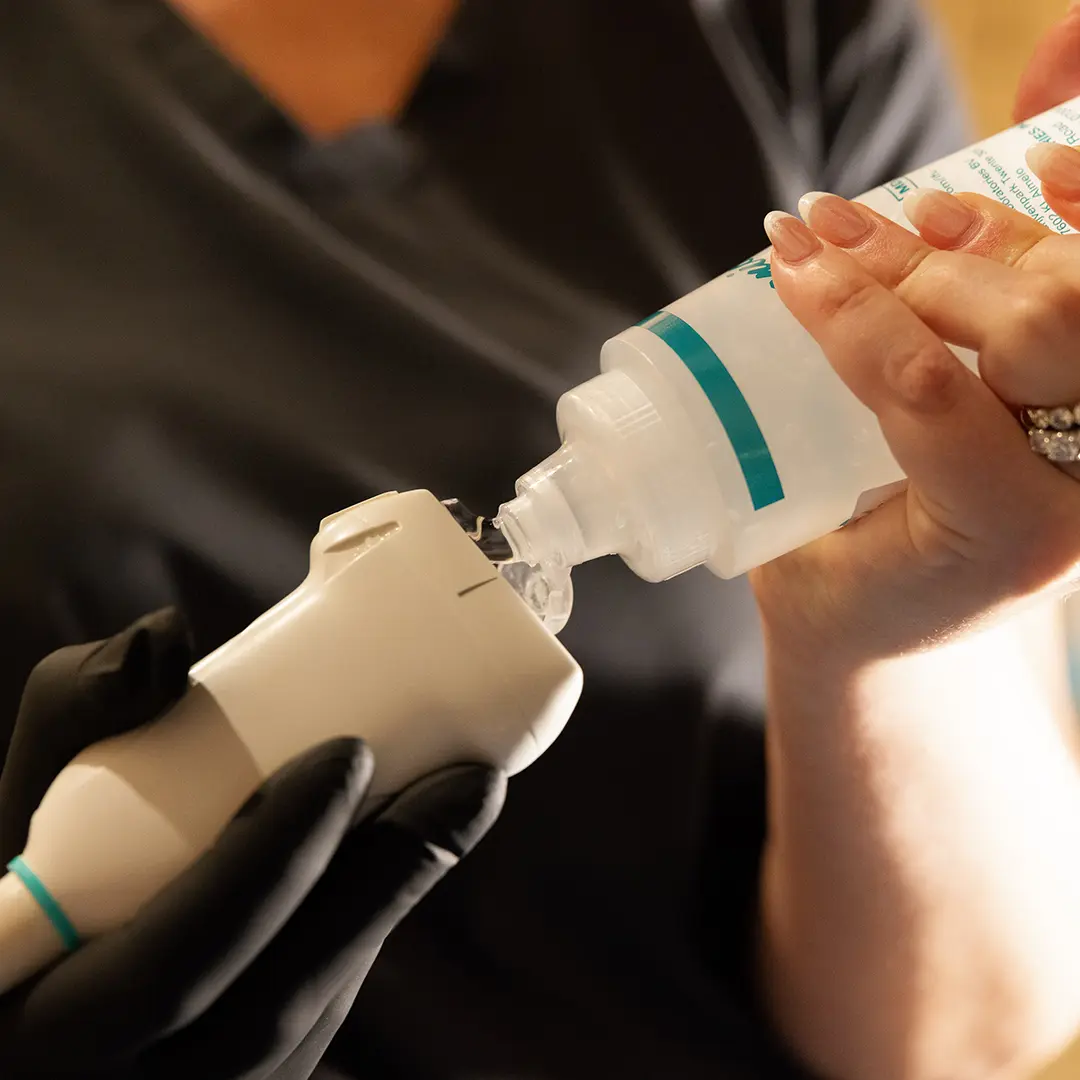
Our Metabolic Screening is a bundle of two ultrasound studies done in one visit: a complete abdominal ultrasound (what our booking page calls the “full belly scan”) and a thyroid ultrasound. The abdominal part covers the liver, gallbladder, kidneys, pancreas, spleen and aorta; the thyroid part covers the gland at the front of the neck. The visit takes about 60 minutes on our booking calendar.
This article explains what each part looks at, the kinds of terms that can appear on the report, what the scan cannot tell you, and what the U.S. Preventive Services Task Force says about scanning people who have no symptoms. If you are thinking about booking one, we would rather you understand both the value and the limits before you do, and talk it through with your doctor first.
Our roles are simple and fixed. Our sonographer performs the scan. A board-certified radiologist reads the images and writes the report. Your own physician interprets that report for you, in the context of your history, labs and symptoms. We never diagnose, and nothing in this article tells you what your own result means.
What the Metabolic Screening includes
| Part | Organs | What the radiologist generally describes |
|---|---|---|
| Complete abdominal ultrasound | Liver | Size, outline, texture and brightness (echogenicity), focal spots or lesions, blood vessels entering the liver |
| Gallbladder and bile ducts | Stones, sludge, polyps, wall thickness, width of the common bile duct | |
| Pancreas | The parts that can be seen, size, texture, duct width, cysts or focal areas | |
| Spleen | Size and texture | |
| Kidneys | Size, outline, cortex, cysts, stones, signs of urine backing up (hydronephrosis) | |
| Aorta | Diameter of the main artery in the abdomen | |
| Thyroid ultrasound | Thyroid gland | Size, texture, nodules or cysts |
The name “Metabolic Screening” refers to the organs most often affected by metabolic health, such as the liver, gallbladder, kidneys and thyroid. It is a structural look at those organs. It does not measure metabolism, blood sugar, cholesterol or hormone levels; those come from blood tests ordered by your doctor.
The liver
The liver is usually the largest organ on the scan and the one people ask about most. A radiologist compares its brightness with the kidney next to it. A liver that looks brighter than usual is often described as “echogenic” or as showing “fatty infiltration” or “steatosis.” Ultrasound is reasonably good at picking up moderate or severe fat: a well-known 2011 meta-analysis in Hepatology found pooled sensitivity of about 85% and specificity of about 94% for moderate to severe fatty liver compared with biopsy. It is less reliable for mild fat, so a normal-looking liver on ultrasound does not rule out a small amount.
Standard ultrasound also cannot reliably measure scarring (fibrosis), which is often what matters most for long-term liver health. The American Association for the Study of Liver Diseases (AASLD) 2023 guidance describes other tools doctors use to estimate scarring, such as blood-test-based scores and elastography. Which, if any, of these apply to you is your physician’s call. For more background, see Fatty liver on ultrasound, Mild fatty infiltration of the liver and Elevated liver enzymes and abdominal ultrasound. Your physician will put any liver finding in context with your history, labs and symptoms.
The gallbladder
Ultrasound is one of the best tests for seeing gallstones, and the gallbladder is why fasting matters (more on that below). The report may describe stones, sludge (thickened bile), polyps, the thickness of the gallbladder wall, and the width of the common bile duct. Gallstones are common: a 2018 review in the Cleveland Clinic Journal of Medicine estimates that about 10% to 15% of U.S. adults have them, and many people with gallstones never develop symptoms. That is a population statistic, not a statement about any one person.
Whether a gallbladder finding matters for you depends on your symptoms and history, and that is a question for your doctor. Our articles Gallbladder ultrasound explained and Gallbladder sludge on an ultrasound report go into more detail.
The pancreas, spleen and kidneys
The pancreas sits deep behind the stomach and bowel, and gas often hides part of it. It is common for a report to say the pancreas was “partially visualized” or “obscured by bowel gas.” That phrase describes how much of the organ could be seen; your doctor will decide whether the view answers their question. Fasting improves the view but does not guarantee it. If your doctor needs a complete look at the pancreas for a specific reason, they may order a different test.
The spleen is measured for size and checked for texture. The kidneys are measured, and the radiologist looks for cysts, stones and widening of the urine-collecting system. Simple kidney cysts become more common with age and are often noted incidentally. Our article Kidney ultrasound: stones, cysts and hydronephrosis explains these terms in general. Ask your doctor what any kidney or spleen description means for you.
The aorta
The complete abdominal study includes the abdominal aorta, the main artery running down through the belly. The radiologist reports its diameter. An abdominal aortic aneurysm (AAA) is typically defined as a diameter of 3.0 cm or larger. If the report mentions the aorta’s size, your doctor will explain what it means and whether any follow-up is appropriate. Our article AAA screening ultrasound covers this in more depth.
The thyroid
The thyroid part of the bundle measures the gland and looks for nodules or cysts. Thyroid nodules are very common on ultrasound: the American Thyroid Association’s 2015 guidelines cite studies finding them in 19% to 68% of randomly selected people. Most are never a problem, but some reports recommend a follow-up scan or a needle sample based on the nodule’s size and its ACR TI-RADS features. Thyroid nodules and TI-RADS explained walks through how radiologists describe them. Your doctor, often with thyroid blood tests, will interpret what a thyroid finding means for you.
Scanning without symptoms: the screening evidence, plainly
Most people who book a Metabolic Screening have no symptoms. It is important to be clear about what the evidence says for that situation.
- Thyroid: The U.S. Preventive Services Task Force (USPSTF) recommends against screening for thyroid cancer in adults without symptoms (grade D, 2017). It concluded that the harms outweigh the benefits.
- Pancreas: The USPSTF recommends against screening for pancreatic cancer in adults without symptoms (grade D, reaffirmed 2019).
- Abdomen in general: The USPSTF does not recommend abdominal ultrasound as a general screening test. The one abdominal ultrasound screen it does recommend is a one-time AAA ultrasound for men aged 65 to 75 who have ever smoked (grade B, 2019), with selective screening for men in that age group who have never smoked (grade C).
A wellness ultrasound is your choice, and some people value a baseline picture of their organs. But it is not a test that has been shown to prevent disease or extend life, and we will not claim that it does. Talk with your doctor before booking, so that you decide with someone who knows your history.
Incidental findings: the trade-off to understand
An incidental finding is something the radiologist sees that has nothing to do with why the scan was done. When you scan several organs in someone without symptoms, incidental findings are common: a small thyroid nodule, a kidney cyst, a spot in the liver, a gallbladder polyp. Most turn out to be harmless, but some lead to more tests, such as repeat ultrasounds, CT or MRI, blood tests, needle samples or specialist visits.
The American College of Radiology created its Incidental Findings Committee because of this problem. Its white paper on abdominal findings notes that most incidental findings are likely benign, that uncertainty often drives further testing, and that unnecessary testing can set off a chain of further tests and procedures with their own costs and risks. Before you book, it is worth asking yourself, and your doctor, how you would want to handle a finding like that. Your physician is the right person to decide whether a reported finding needs any follow-up.
What the Metabolic Screening is not
- Not bloodwork. It does not measure blood sugar, A1c, cholesterol, liver enzymes or thyroid hormone. We do not draw blood; your doctor can order labs at Quest, Labcorp or another lab.
- Not a cancer screen. Ultrasound can show some masses but misses others, and it cannot say what a mass is. See Can an ultrasound detect cancer?
- Not a heart or artery test. It does not look at the heart or the arteries in the neck. Our Vascular Screening is a separate bundle.
- Not a bowel test. Ultrasound does not see the inside of the stomach or intestines well.
- Not a substitute for your doctor. It does not replace a physical exam, a medical history or the screenings your doctor recommends for your age.
Who chooses this bundle
People usually book the Metabolic Screening for one of two reasons. Some have talked with their doctor and decided they want a baseline picture of these organs, knowing the trade-offs above. Others have a doctor who wants both an abdominal and a thyroid study and finds it convenient to have them done in one visit. If your doctor has asked for a specific study, such as a limited abdominal ultrasound of the gallbladder only, book that study instead; the bundle is not a substitute for what your doctor asked for. Our article Wellness ultrasound packages compares our bundles.
If symptoms are what prompted you to look, such as pain in the upper abdomen, yellowing of the skin or eyes, or a neck lump, talk with your doctor first. The right test for a symptom may be different. Our article Upper abdominal pain: ultrasound or the ER? explains when pain needs urgent care.
When to go to the ER or call 911
A scheduled scan is not the right step for urgent symptoms. Go to an emergency department or call 911 for severe or worsening abdominal pain, pain with fever and vomiting, yellowing of the skin or eyes with pain or fever, vomiting blood or black stools, sudden severe belly or back pain that feels like tearing, or trouble breathing or swallowing with a neck swelling.
How to prepare
| Part | Prep | Why |
|---|---|---|
| Complete abdominal | Nothing to eat for 8 hours; water and your regular medications are fine | Eating makes the gallbladder contract and adds gas that hides the pancreas and other organs |
| Thyroid | No prep; wear an open neckline | Easy access to the front of the neck |
Because the bundle includes the abdomen, the 8-hour fast applies to the whole visit. Many people book a morning time so the fast falls overnight. If you manage diabetes or take medication that needs food, ask the doctor who manages it how to handle your medication while fasting. Our guide How to prepare for an ultrasound covers prep for every study.
Questions to ask your doctor
Before booking:
- Given my history, is a wellness ultrasound worthwhile for me, or would other tests tell us more?
- Are there blood tests you would want alongside it?
- If the scan finds something small and probably harmless, how would we decide whether to follow it up?
After the report:
- Which findings, if any, matter for me, and which are common and expected?
- Does the report recommend follow-up, and do you agree with it?
- Should this become a baseline we compare against in the future?
Our guide What does my ultrasound report mean? explains the “findings” and “impression” sections so you can follow along.
How booking works
You book the Metabolic Screening online on our booking page; no referral is needed. The booking form asks for the name of the doctor who should receive the report (type “None” if you do not have one) and offers an optional referral upload. Payment is a flat rate paid when you book, with no facility fee, and HSA/FSA cards are accepted. You can come to our clinic, or we bring the scan to you at home in our California service areas.
The visit takes about 60 minutes. Our sonographer will not give results at the visit. A board-certified radiologist reads every study; the report is ready within 24 hours and is sent to you and, if named, your doctor. Then your physician will go through it with you.
Getting a scan with us: our thyroid ultrasound page explains what the scan covers and how to prepare. You can book online for our clinic, or we bring the scan to you at home. A board-certified radiologist reads every study, and the report is ready within 24 hours. Your own doctor interprets the results for you.
Sources
- U.S. Preventive Services Task Force. Thyroid Cancer: Screening (2017)
- U.S. Preventive Services Task Force. Pancreatic Cancer: Screening (2019 reaffirmation)
- U.S. Preventive Services Task Force. Abdominal Aortic Aneurysm: Screening (2019)
- Hernaez R et al. Diagnostic accuracy and reliability of ultrasonography for the detection of fatty liver: a meta-analysis. Hepatology, 2011
- Rinella ME et al. AASLD Practice Guidance on the clinical assessment and management of nonalcoholic fatty liver disease. Hepatology, 2023
- Ibrahim M et al. Gallstones: Watch and wait, or intervene? Cleveland Clinic Journal of Medicine, 2018
- Haugen BR et al. 2015 American Thyroid Association Management Guidelines for Adult Patients with Thyroid Nodules and Differentiated Thyroid Cancer. Thyroid, 2016
- Berland LL et al. Managing Incidental Findings on Abdominal CT: White Paper of the ACR Incidental Findings Committee. J Am Coll Radiol, 2010
Frequently asked questions
What does the Metabolic Screening include?
It combines a complete abdominal ultrasound (liver, gallbladder, kidneys, pancreas, spleen and aorta) with a thyroid ultrasound, in one visit of about 60 minutes. A board-certified radiologist reads both studies and writes the report.
Do I need to fast for the Metabolic Screening?
Yes. Because it includes the abdomen, have nothing to eat for 8 hours before the visit; water and your regular medications are fine. The thyroid part needs no prep, so wear an open neckline. If you manage diabetes, ask the doctor who manages it how to handle your medication while fasting.
Does the USPSTF recommend this kind of screening?
No. The USPSTF recommends against thyroid cancer screening in adults without symptoms (grade D, 2017) and against pancreatic cancer screening in adults without symptoms (grade D, 2019), and it does not recommend abdominal ultrasound as a general screen. Its one abdominal ultrasound screening recommendation is one-time AAA screening for men aged 65 to 75 who have ever smoked. A wellness scan is your choice; talk with your doctor before booking.
Can this scan check my cholesterol, blood sugar or thyroid levels?
No. Ultrasound shows the structure of organs, not blood chemistry. Cholesterol, blood sugar, liver enzymes and thyroid hormone levels come from blood tests ordered by your doctor. We do not draw blood; labs such as Quest or Labcorp do.
What if the scan finds something unexpected?
Incidental findings such as a small thyroid nodule or kidney cyst are common when several organs are scanned. The radiologist describes what is seen and may suggest follow-up. Your doctor decides whether anything further is needed, which can include repeat scans or other tests. It is worth discussing this possibility with your doctor before you book.
Do I need a referral, and who gets the report?
No referral is needed. The booking form asks for the name of the doctor who should receive the report; type None if you do not have one, and there is an optional referral upload. The report is ready within 24 hours and goes to you and, if named, your doctor.
This article is general health information, not medical advice. It does not replace a conversation with your own physician, who knows your history and can interpret results in context. If you have symptoms that worry you, contact your doctor; if you think you are having a medical emergency, call 911.