
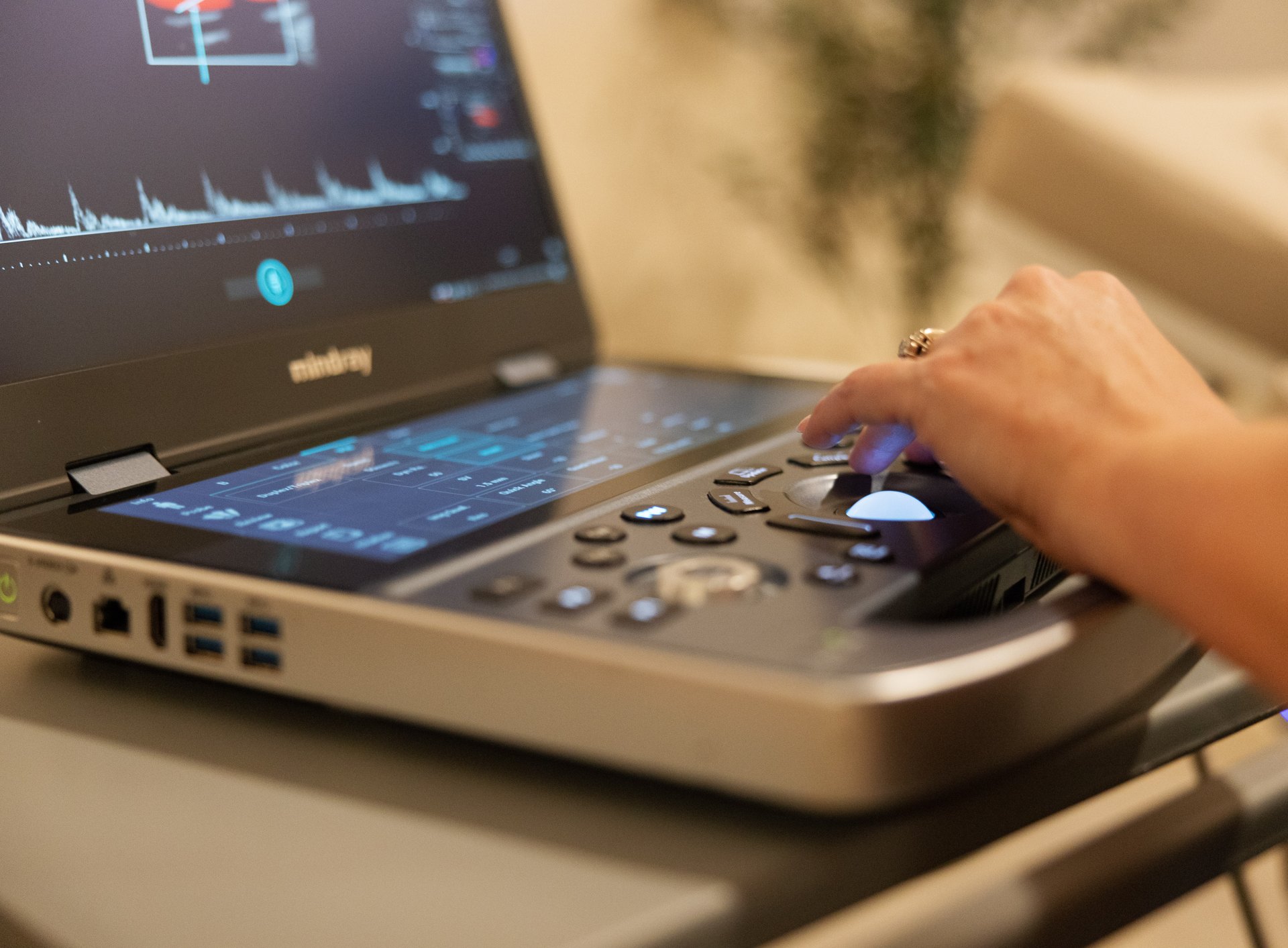
Pain under the ribs or in the pit of the stomach is one of the most common reasons people end up searching for “upper abdominal pain.” The causes range from heartburn and a stomach bug to gallstones, an inflamed pancreas, a kidney stone, and occasionally something that has nothing to do with the belly at all, like a heart attack. Where the pain sits, what triggers it, and what comes with it all help narrow things down.
This guide walks through likely causes by location, which organs ultrasound sees clearly and which it does not, the warning signs that mean you should go to an emergency room or call 911 instead of booking a scan, and how to prepare if an abdominal ultrasound is the right next step. Use it to talk with your doctor, not to self-diagnose.
First: is this an ER visit?
Start here, because some upper abdominal pain cannot wait for an appointment. Call 911 or go to the nearest emergency department if you have:
- Chest pain, pressure, or tightness, or upper belly pain with shortness of breath, sweating, nausea, lightheadedness, or pain spreading to the arm, back, neck, or jaw. Heart attacks, particularly in women, people with diabetes, and older adults, can feel like indigestion or upper abdominal pain.
- Severe, sudden, or steadily worsening pain, especially if you cannot sit still or the belly is rigid and very tender to touch.
- Fever with yellow skin or eyes, or fever and chills with right upper abdominal pain. This combination can mean an infected, blocked bile duct (cholangitis), which is an emergency.
- Vomiting blood or material that looks like coffee grounds, or black, tarry stools.
- Sudden severe pain in the belly or back with fainting, or a pulsing mass, especially if you have a known abdominal aortic aneurysm.
- Pain that goes straight through to the back with repeated vomiting, a pattern that can be pancreatitis.
- Persistent vomiting and inability to keep fluids down.
- You are or could be pregnant. Early in pregnancy, belly pain with bleeding, shoulder pain, or dizziness can be an ectopic pregnancy. Later in pregnancy or after delivery, right upper abdominal pain with headache, vision changes, or swelling can signal preeclampsia. Call your OB or labor and delivery, or 911 if severe.
If none of these apply and the pain is mild, intermittent, or recurring, a scheduled evaluation with your doctor, and often an ultrasound, is reasonable.
Causes by location
The upper abdomen is usually divided into three zones. Pain does not always respect the boundaries, but location is a useful starting point.
| Location | Common causes | Clues |
|---|---|---|
| Right upper (under the right ribs) | Gallstones and biliary colic, inflamed gallbladder (cholecystitis), hepatitis, liver congestion, right kidney stone or infection, lower right lung pneumonia | Gallbladder pain often follows fatty meals, lasts 30 minutes to several hours, and may spread to the right shoulder blade |
| Center (epigastric, below the breastbone) | Reflux, gastritis, peptic ulcer, pancreatitis, gallbladder pain, heart attack, aortic aneurysm | Burning that improves with antacids suggests reflux or ulcer; pain boring through to the back raises concern for pancreatitis |
| Left upper (under the left ribs) | Stomach problems, spleen enlargement or injury, tail of the pancreas, left kidney stone or infection, lower left lung pneumonia | Recent injury or infections such as mononucleosis can involve the spleen |
| Flank (side or back, below the ribs) | Kidney stone, kidney infection, muscle strain | Stone pain often comes in waves and moves toward the groin; fever with flank pain needs prompt care |
What ultrasound sees well
Ultrasound is quick, uses no radiation, and is very good at solid and fluid-filled organs that are not hidden behind gas or bone. For right upper abdominal pain, the American College of Radiology’s Appropriateness Criteria rate ultrasound as the usual first imaging test, because it is so good at the gallbladder.
- Gallbladder: gallstones, sludge, a thickened wall, fluid around the gallbladder, and tenderness when the probe presses over it. See gallbladder ultrasound explained.
- Bile ducts: whether they are wider than expected, which can mean a blockage downstream.
- Liver: fatty liver, masses, cysts, signs of scarring. Our fatty liver guide covers the most common finding.
- Kidneys: stones, swelling of the drainage system (hydronephrosis), cysts. See kidney ultrasound.
- Spleen: size and focal lesions.
- Abdominal aorta: diameter, to check for an aneurysm. See AAA screening.
What ultrasound sees less well
- Pancreas: it sits deep behind the stomach and bowel. Gas often hides part or all of it, especially the tail. Pancreatitis is mainly diagnosed with symptoms and a lipase blood test, and CT is used when the picture is unclear or complications are suspected.
- Stomach and duodenum: ulcers, gastritis, and reflux are not ultrasound diagnoses. Endoscopy, H. pylori testing, or a trial of treatment are the usual tools.
- Bowel: obstruction, inflammation, and many causes of pain lower in the abdomen are usually evaluated with CT in adults.
- The heart and lungs: a heart attack needs an ECG and blood tests in an emergency setting, not an abdominal scan.
That means a normal abdominal ultrasound is genuinely useful information, since it makes gallstones and several other causes much less likely, but it does not rule out every cause of upper abdominal pain.
Typical scenarios
| Scenario | What is often considered first (your doctor decides) |
|---|---|
| Episodes of right upper pain after meals, lasting an hour or two, now resolved | Abdominal or gallbladder ultrasound |
| Burning epigastric pain, worse when hungry, better with antacids | Medication trial, H. pylori testing, possibly endoscopy |
| Upper pain with abnormal liver tests | Abdominal ultrasound plus blood work |
| Constant severe pain radiating to the back with vomiting | Emergency evaluation; lipase blood test and often CT |
| Wave-like flank pain moving to the groin | Urgent evaluation; urinalysis and kidney imaging |
| Upper pain with exertion, shortness of breath, or sweating | Call 911; cardiac evaluation |
Questions your doctor may ask
Thinking through these before your visit makes the appointment more productive:
- Where exactly is the pain, and does it move anywhere (shoulder blade, back, groin)?
- When did it start, how long do episodes last, and are they getting more frequent?
- Is it related to meals, fatty foods, alcohol, lying down, or exertion?
- Have you had fever, chills, yellowing of the eyes, dark urine, or pale stools?
- Any vomiting, black stools, or weight loss?
- What medications do you take, especially anti-inflammatory pain relievers like ibuprofen or naproxen, which can cause ulcers?
- Could you be pregnant?
How to prepare for an abdominal ultrasound
For a complete or limited abdominal ultrasound, a gallbladder study, or an AAA screening, have nothing to eat for 8 hours before the scan. Water and your regular medications are fine. Fasting keeps the gallbladder full so stones and wall changes are visible, and it reduces bowel gas that can block the view of the pancreas and aorta.
If your doctor has asked for a renal and bladder ultrasound instead, the prep is different: drink about 32 oz of water an hour before and do not empty your bladder. If you are not sure which study you need, check your referral or ask us when you book. Our ultrasound prep guide lists every exam.
What happens during the scan
You lie on your back, sometimes rolling onto your left side. Our sonographer applies warm gel and moves the probe under your ribs and across your upper belly. You may be asked to take a deep breath and hold it, which pushes the liver and gallbladder down into view. A complete abdominal study typically takes around 30 minutes. If a particular spot hurts when pressed, say so, because tenderness directly over the gallbladder is a useful finding.
The sonographer captures images but does not give a diagnosis during the scan; that is the radiologist’s role. Here is why. If anything you are feeling changes during or after the visit, such as worsening pain or fever, do not wait for the report; contact your doctor or go to the ER.
Getting your scan with us
Abdominal, gallbladder, and AAA ultrasounds can be booked directly; no referral is required, though bringing your doctor’s referral helps the radiologist answer the right question. You can book online at our clinic, or we bring the scan to you at home or work in our California service areas. Pricing is a flat rate paid when you book, with no facility fee, and HSA/FSA is accepted.
A board-certified radiologist reads every study, and the report is ready within 24 hours. It is sent to you and, if named, your doctor. Read what your ultrasound report means for help with the terms, and go over results with your doctor. An ultrasound is for stable, non-emergency pain; anything on the ER list above needs emergency care first.
Getting a scan with us: our abdominal ultrasound page explains what the scan covers and how to prepare. You can book online for our clinic, or we bring the scan to you at home. A board-certified radiologist reads every study, and the report is ready within 24 hours. Your own doctor interprets the results for you.
Sources
- ACR Appropriateness Criteria: Right Upper Quadrant Pain
- American Family Physician: Diagnostic Imaging of Acute Abdominal Pain in Adults (2015, PDF)
- RadiologyInfo (ACR/RSNA): Abdominal Ultrasound
- American Heart Association: Women, your heart attack may look different
- Mayo Clinic: Heart attack symptoms
Frequently asked questions
What organs are in the upper abdomen?
The upper abdomen contains the liver, gallbladder, bile ducts, stomach, the first part of the small intestine, pancreas, spleen, and the upper parts of the kidneys and abdominal aorta. The bottom of the lungs and the heart sit just above it, which is why heart and lung problems can feel like belly pain.
Can an ultrasound find the cause of upper abdominal pain?
Often. Ultrasound is the usual first test for right upper abdominal pain because it is very good at gallstones and gallbladder inflammation, and it also shows the liver, bile ducts, kidneys, spleen, and aorta. It is limited for the pancreas, stomach, and bowel, so a normal ultrasound does not rule out every cause.
Can ultrasound diagnose pancreatitis?
Not reliably on its own. The pancreas is often partly hidden by bowel gas. Pancreatitis is usually diagnosed with symptoms and a lipase blood test, and CT is used when needed. Ultrasound is still useful to look for gallstones, a common cause of pancreatitis.
When is upper abdominal pain an emergency?
Call 911 or go to the ER for chest pain or pressure, pain with shortness of breath or sweating, severe or worsening pain, fever with yellow skin or eyes, vomiting blood or black stools, sudden pain with fainting, persistent vomiting, or belly pain during pregnancy.
Do I need to fast before an abdominal ultrasound?
Yes. Have nothing to eat for 8 hours before an abdominal, gallbladder, or AAA ultrasound. Water and regular medications are fine. A kidney and bladder study instead needs a full bladder.
Do I need a referral for an abdominal ultrasound?
No. You can book directly. A board-certified radiologist reads every study and the report is ready within 24 hours, sent to you and, if named, your doctor.
This article is general health information, not medical advice. It does not replace a conversation with your own physician, who knows your history and can interpret results in context. If you have symptoms that worry you, contact your doctor; if you think you are having a medical emergency, call 911.