
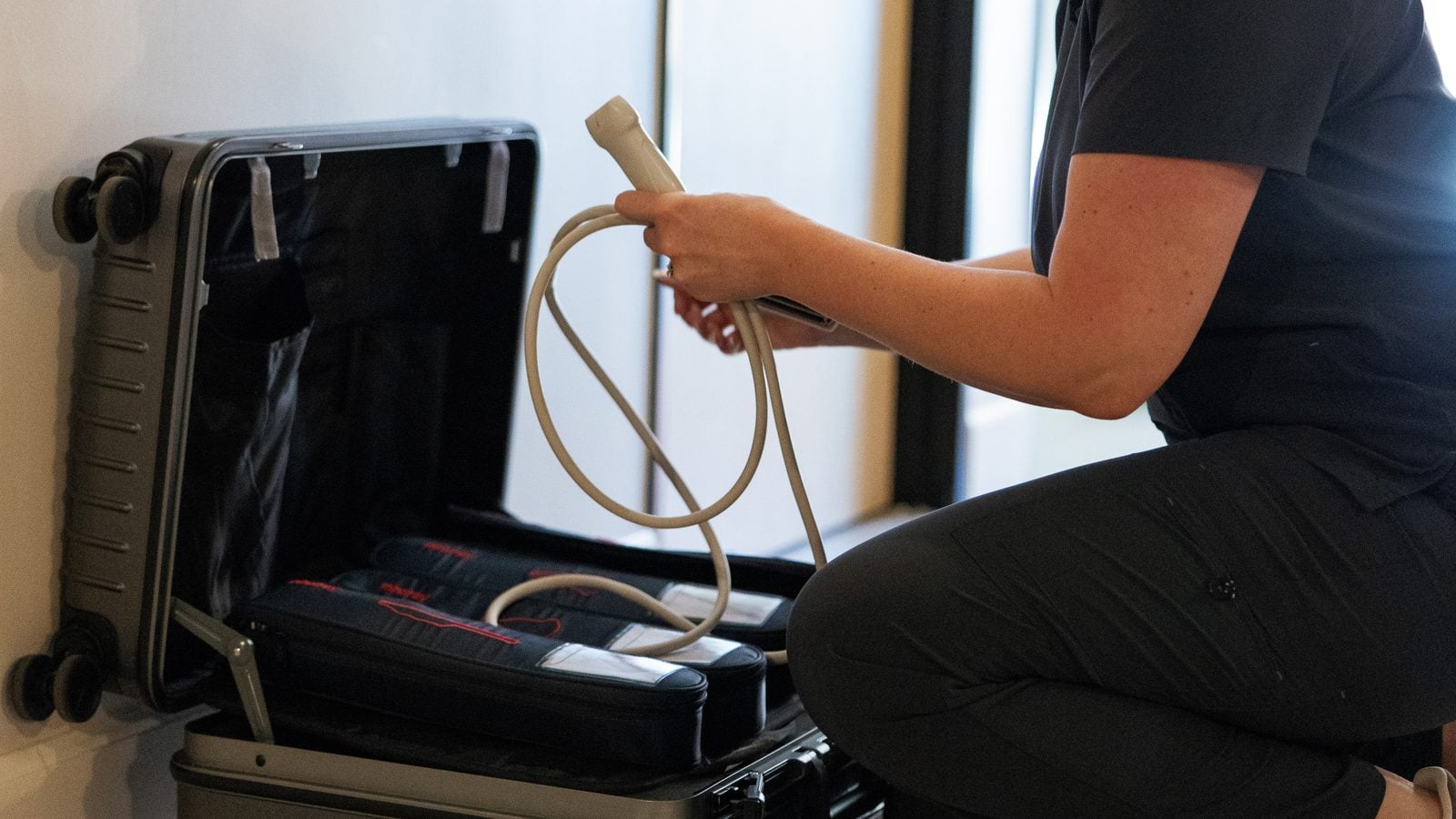
If your doctor has suggested an ultrasound, or you want one for peace of mind, you have more choices than you might think. You can go to a hospital imaging department, an independent imaging center, or, increasingly, have a credentialed sonographer bring the scan to your home, workplace or care facility. Each option has real strengths, and each is the wrong choice in certain situations.
This guide compares the three side by side: wait times, cost structure, convenience, equipment, who performs and interprets the study, privacy and accessibility. We are upfront about when the hospital or emergency room is the right place, and we explain exactly how home visits work with us.
The comparison at a glance
| Factor | Mobile home visit | Hospital (outpatient or ER) | Independent imaging center |
|---|---|---|---|
| Typical wait for a planned scan | Often scheduled within days, at a time that suits you | Varies widely; outpatient slots can be booked out; the ER sees urgent cases first and non-urgent cases can wait for hours | Often days; varies by center and region |
| Cost structure | Often a single rate; ask whether travel is included (ours: flat rate paid when you book, no facility fee, no bill afterward) | Often a facility fee plus a separate professional (radiologist) fee; final bill can arrive later | Often one global price; some bill the reading separately |
| Convenience | No driving, parking or waiting room; we bring the scan to you | Travel, parking, registration, waiting | Travel and some waiting; usually easier than a hospital |
| Equipment | Portable diagnostic ultrasound system | Fixed, cart-based systems plus CT, MRI and other modalities on site | Fixed, cart-based systems; some offer CT or MRI |
| Who performs the scan | A credentialed sonographer | A sonographer, or for bedside ER scans, often an emergency physician | A credentialed sonographer |
| Who interprets | Depends on provider; with us, a board-certified radiologist reads every diagnostic study | Radiologist; ER bedside scans are interpreted by the treating physician | Usually a radiologist |
| Report timing | Depends on provider; ours is ready within 24 hours | Fast for emergencies; outpatient timing varies | Varies; often a day or more |
| Privacy | Your own space; you choose who is present | Shared waiting areas and busy departments | Shared waiting areas |
| Best for | Planned, non-urgent studies; mobility limits; new parents; monitoring schedules | Emergencies, inpatients, CT or MRI, procedures, immediate results | Planned studies when travel is easy; when you may need other imaging the center offers |
Everything in the table is general. Individual hospitals, centers and mobile providers vary, so ask the questions near the end of this article wherever you book.
Wait times and scheduling
Hospital imaging departments serve emergency, inpatient and outpatient needs at the same time, and urgent cases come first. That is exactly what you want in an emergency, but it can mean longer waits for a planned outpatient scan. In an emergency department, triage determines the order of care, so a non-urgent ultrasound can wait behind sicker patients.
Independent imaging centers focus on scheduled outpatient work, so scheduling is often more predictable. Mobile providers work around your calendar, which matters when you are coordinating childcare, work, a care facility’s schedule, or a time-sensitive monitoring plan from a fertility clinic or surrogacy agency.
Cost structure (without the numbers)
The biggest driver of cost differences is not the scan but the setting. Hospital outpatient departments commonly bill a facility fee in addition to the radiologist’s professional fee, and those may arrive as separate bills. Independent centers and mobile providers usually bill a single amount. Research from the Health Care Cost Institute found hospital outpatient prices for imaging without contrast were roughly 2.6 to 3.7 times physician-office prices for commercially insured patients in 2022. Our guide on what affects the cost of an ultrasound without insurance goes deeper, including your right to a Good Faith Estimate as a self-pay patient.
Equipment: portable vs. fixed systems
Hospitals and imaging centers use large, cart-based ultrasound systems that stay in one room. Mobile providers use portable diagnostic systems designed to travel. Portable technology has improved substantially, and for most routine studies the factors that matter most are the sonographer’s skill, the protocol followed, and the patient’s anatomy.
Evidence is still developing, but it is encouraging. A 2024 randomized trial published in the Western Journal of Emergency Medicine compared a handheld device with a cart-based system in three emergency departments and found similar diagnostic accuracy, while the cart-based system scored somewhat higher on image quality. The study was small and industry-funded, and handheld devices differ from the larger portable systems many mobile services use, so it is one data point rather than the final word.
Some limitations apply to every ultrasound, regardless of the machine. According to RadiologyInfo, produced by the American College of Radiology and the Radiological Society of North America, sound waves do not pass well through gas or bone, which limits views of the bowel, lungs and the inside of bones, and imaging is harder in patients with more tissue between the probe and the organ. When those limits matter, your doctor may recommend CT or MRI instead.
Who performs and who interprets the study
Two people are involved in a diagnostic ultrasound. A sonographer acquires the images, following a protocol for that exam. Many sonographers hold credentials from the American Registry for Diagnostic Medical Sonography (ARDMS). A physician, usually a radiologist, interprets the images and signs a written report.
In emergency departments, physicians often perform focused bedside ultrasound (point-of-care ultrasound) to answer a specific question quickly, such as whether there is fluid around the heart. That is a different service from a complete diagnostic study read by a radiologist. Whatever setting you choose, it is reasonable to ask who will read your study and how you will get the report. Sonographers generally do not share findings during the scan; our article on why the sonographer will not tell you what they see explains why.
When the hospital or ER is the right place
A home visit or imaging center is not the right choice for everything. Choose the emergency department, or call 911, for:
- Chest pain, sudden shortness of breath, or coughing up blood, especially with a painful, swollen leg (possible blood clot in the lungs)
- Sudden, severe abdominal or pelvic pain, particularly with fever, vomiting, fainting or a rigid belly
- Pain or bleeding in early pregnancy with dizziness, fainting or shoulder pain (possible ectopic pregnancy)
- Heavy vaginal bleeding
- Sudden, severe testicular pain or swelling (possible torsion, which is time-sensitive)
- Stroke symptoms: face drooping, arm weakness, speech difficulty, sudden confusion or vision loss
- Significant trauma
The hospital is also the better fit when:
- You may need CT or MRI. Many questions, such as trauma, suspected stroke, and many causes of acute abdominal pain in adults, are better answered with CT or MRI, which mobile providers do not offer. The American College of Radiology’s Appropriateness Criteria help doctors choose the right test.
- You need results immediately. Emergency departments can obtain urgent interpretations. Planned outpatient and home-visit studies, including ours, are not stat reads.
- You are already an inpatient or in a skilled care setting that provides its own imaging.
- You need a procedure, such as an ultrasound-guided biopsy, injection or drainage, or a specialized study like a saline sonogram. We do not perform these.
If you have known risk factors for a blood clot and leg symptoms but no chest symptoms, contact your doctor promptly; our guide to DVT ultrasound explains when a scan is appropriate.
Privacy
For many people, especially for pelvic, breast, scrotal or pregnancy studies, privacy is a big part of the decision. At home there is no waiting room, no check-in desk and no strangers walking past, and you decide who is in the room, whether that is a partner, a support person or no one. Hospitals and imaging centers protect your privacy too, under the same federal health privacy rules, but they are shared, busy spaces. Whatever the setting, you can ask who will be present.
Accessibility: who benefits most from a home visit
- People with mobility limits: wheelchair users, older adults, people recovering from surgery, and residents of care facilities, for whom transport can be the hardest part of the appointment.
- New parents, who may not want to bring a newborn into a waiting room or arrange childcare.
- Gestational carriers and fertility patients on monitoring schedules, where timing matters and travel adds up. See our guide to remote ultrasound monitoring for surrogacy agencies and follicle tracking.
- People with anxiety about medical settings, who may find their own space calmer.
- Busy professionals, who can schedule a scan at home or the workplace instead of losing half a day.
- People far from imaging centers, for whom the round trip is long.
Home visits have limits of their own. You need a bed or sofa and a bit of space, and pets and noise can be a distraction. Preparation still matters; see how to prepare for an ultrasound.
Questions to ask any provider
- Who performs the scan, and what credentials do they hold?
- Who interprets it? Is a radiologist’s report included?
- When will the report be ready, and who receives it?
- Is the price the total, including the reading, with no bill afterward? Is there a facility fee or travel charge?
- Do I need a referral for this study?
- What preparation is needed?
- What happens if the study shows something that needs follow-up?
- Can I get a superbill or itemized receipt for insurance or my HSA or FSA?
How home visits work with us
We bring the scan to you across our California service areas, to your home, workplace or care facility, with the same sonographer, equipment and report timing as a clinic visit.
- Book online on our booking page. Enter your ZIP code to see available times and your rate. Most studies can be booked directly; DVT studies and the second-trimester anatomy scan require a referral (for DVT, you can upload it when you book online or call (916) 751-1944 to book). Learn more in do you need a referral for an ultrasound.
- Pay when you book. A flat rate, no facility fee, no bill afterward. HSA and FSA cards are accepted, and a superbill is available on request.
- Prepare. Abdominal, gallbladder, aortic aneurysm, and metabolic or vascular bundles that include the abdomen: nothing to eat for 8 hours (water and medications are fine). Kidney and bladder, prostate, transabdominal pelvic and first-trimester scans: a full bladder (drink 32 ounces of water an hour before and do not empty). Combined transabdominal and transvaginal pelvic scans: a full bladder for the first part, then you empty before the transvaginal part. Second-trimester anatomy and growth scans: no preparation. Thyroid: no preparation; wear an open neckline. Breast: no lotion, powder or deodorant. Transvaginal-only lining or follicle checks: an empty bladder.
- Our sonographer arrives with a portable diagnostic system and performs the scan where you are comfortable.
- A board-certified radiologist reads every diagnostic study, and the report is ready within 24 hours. It goes to you and, if you name one, your doctor. See what does my ultrasound report mean.
Elective heartbeat and gender visits are non-diagnostic, include no radiologist report, and do not replace the scans your OB recommends. We do not draw blood; bloodwork is done at Quest or Labcorp. For more on why patients choose home imaging, see 5 benefits of mobile ultrasound. Talk with your doctor about which setting and study are right for you.
Getting a scan with us: our ultrasound services page lists every scan we offer. You can book online for our clinic, or we bring the scan to you at home. A board-certified radiologist reads every study, and the report is ready within 24 hours. Your own doctor interprets the results for you.
Sources
- RadiologyInfo.org (ACR/RSNA): General Ultrasound
- Gibbons RC et al. Diagnostic Accuracy of a Handheld Ultrasound vs a Cart-based Model: A Randomized Clinical Trial. West J Emerg Med. 2024
- American College of Radiology: ACR Appropriateness Criteria
- U.S. FDA: Ultrasound Imaging
- CDC: About Venous Thromboembolism (Blood Clots)
- Health Care Cost Institute: Trends in prices for site-neutral services in hospital outpatient and physician office settings
- CMS: Know your medical bill rights when not using insurance
Frequently asked questions
Is a portable ultrasound as accurate as a hospital machine?
For many routine diagnostic studies, modern portable systems perform well, and image quality depends heavily on the sonographer’s skill and the patient’s anatomy. A 2024 randomized trial in the Western Journal of Emergency Medicine found similar diagnostic accuracy between a handheld device and a cart-based system, although the cart-based system had somewhat higher image quality scores. Talk with your doctor if your study needs a specialized exam best done on a fixed system.
When should I go to the hospital or ER instead of booking an ultrasound?
Go to the ER or call 911 for chest pain, sudden shortness of breath, a painful swollen leg with breathing trouble, sudden severe abdominal, pelvic or testicular pain, heavy bleeding, fainting, stroke symptoms, or pain and bleeding in early pregnancy. The hospital is also the right place when you may need CT or MRI, an immediate read, a procedure, or you are already an inpatient.
Who reads a home-visit ultrasound?
With us, our sonographer performs the scan and a board-certified radiologist reads every diagnostic study. The report is ready within 24 hours and goes to you and, if you name one, your doctor. Elective heartbeat and gender visits are non-diagnostic and do not include a radiologist report.
Do I need a referral for a home-visit ultrasound?
Most of our studies can be booked directly without a referral. DVT studies and the second-trimester anatomy scan require one; for DVT, you can upload it when you book online or call (916) 751-1944 to book.
What do I need at home for a mobile ultrasound?
A bed or sofa where you can lie comfortably, a little space for the sonographer and the portable system, and some privacy. Follow the same preparation as a clinic visit, such as fasting for abdominal studies or a full bladder for certain pelvic and early pregnancy scans.
Is a home visit more private than a hospital or imaging center?
For many people, yes. There is no waiting room, no check-in desk and no travel, and you choose who is in the room. As in any setting, the exam follows professional standards for patient privacy and dignity.
This article is general health information, not medical advice. It does not replace a conversation with your own physician, who knows your history and can interpret results in context. If you have symptoms that worry you, contact your doctor; if you think you are having a medical emergency, call 911.