
Many gestational carriers live hours from the IVF clinic managing their cycle, and some live hours from any imaging center at all. For agencies, these carriers are often wonderful matches whose journeys are complicated mainly by logistics: long drives for 15-minute scans, overnight stays, childcare, and time off work. This article looks at the options for monitoring rural and out-of-area carriers, and how mobile ultrasound can reduce travel without slowing the IVF clinic down.
Where the travel burden comes from
In a typical journey, a carrier may need a screening scan, a baseline scan, one to three lining checks, and several early pregnancy scans before release to her OB, plus bloodwork along the way. The transfer itself must happen at the IVF clinic, but most of the rest can be done elsewhere. Our carrier medical timeline lists each step.
When there is no suitable site nearby, agency guides describe carriers driving long distances or staying overnight, with intended parents covering mileage, meals, lodging and lost wages. Many outside-monitoring sites also see patients only on weekdays, which can collide with cycle-day timing.
The options for out-of-area monitoring
| Option | Advantages | Drawbacks |
|---|---|---|
| Travel to the IVF clinic | One team, familiar protocol | Most travel, cost and time off |
| A local fertility clinic | Experienced with monitoring, often does bloodwork | May not exist nearby; scheduling and fees vary |
| A hospital or radiology center | Widely available | May not be familiar with cycle-timed lining checks; scheduling can be slow |
| Mobile ultrasound at home | Least travel; easy to fit around work and kids | Limited to the provider’s service area; bloodwork still needs a lab |
How mobile monitoring works
- The IVF clinic or agency sends a written order with the study, cycle-day window and where results go.
- The provider contacts the carrier to book a time within the window.
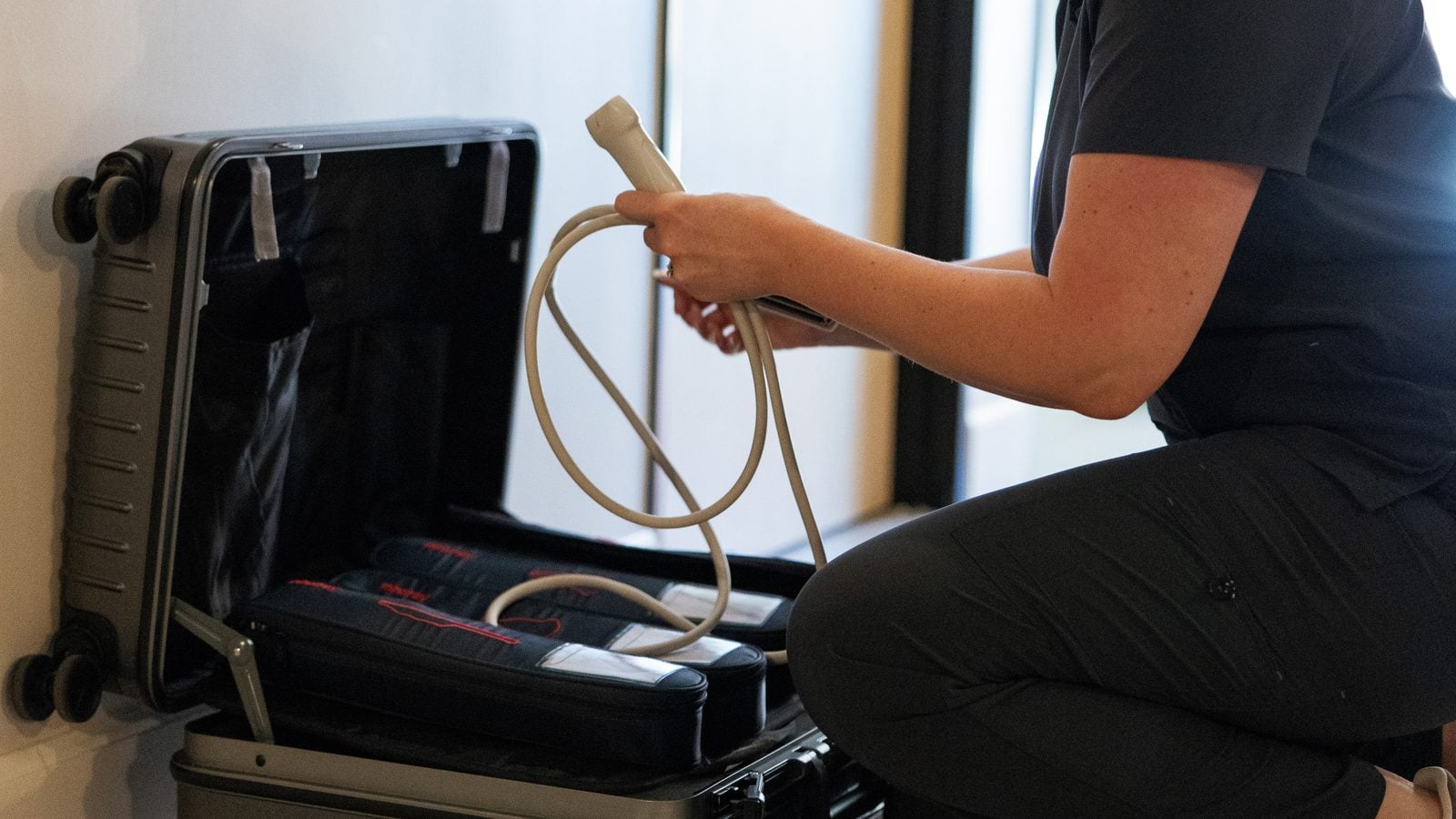
- A registered sonographer brings a portable ultrasound system to the carrier’s home and performs the scan in privacy.
- The images are read and the report is sent to the IVF clinic named on the order.
- The carrier visits a nearby lab for any ordered bloodwork.
Modern portable systems produce diagnostic-quality transvaginal images for lining checks and early pregnancy scans. What matters most is the training of the sonographer and the reading radiologist, and clear agreement with the IVF clinic on what is measured and when results are needed.
Questions agencies should settle up front
- Does the provider cover the carrier’s address? (Check before matching if possible.)
- Which days and how far ahead can it book, given cycle-day windows?
- How and when do results reach the IVF clinic?
- What does it cost per visit, and can it be invoiced to escrow or the agency directly?
- Who is the single contact for repeat carriers?
Our complete remote monitoring guide for agencies covers paperwork, privacy and the ten questions to ask any monitoring partner.
What it saves
Every visit done at home can save a carrier several hours of driving and the intended parents the matching reimbursement. Over a full journey with multiple scans, that difference adds up, and it often matters as much to the carrier’s experience as to the budget.
Mobile monitoring with UltraVision Imaging
We bring pelvic, lining-check and early pregnancy ultrasounds to patients’ homes across our California service areas, or see them at our clinic. A board-certified radiologist reads every study, with the report ready within 24 hours and sent to the IVF clinic on the order. Pricing is a flat rate per visit with no facility fee, and visits can be invoiced to the agency or payer. Agencies can check a carrier’s ZIP code on our booking page, send an order through our referral page, or call (916) 751-1944 to set up an account.
Matching with distance in mind
Agencies increasingly check monitoring logistics during matching, before a carrier is cleared. A short checklist at that stage prevents surprises later: the distance to the IVF clinic and to the nearest monitoring option, whether that option offers transvaginal lining checks and early pregnancy scans, how the carrier will reach a lab for bloodwork, and her work and childcare constraints. Carriers who live farther away are often outstanding candidates; they simply need a plan.
A sample monitoring plan for a rural carrier
| Step | Where | Notes |
|---|---|---|
| Screening scan and saline sonogram | IVF clinic or a fertility clinic nearer home | Often combined with other screening on one trip |
| Baseline scan | Mobile or local imaging | Timed to the start of medications |
| Lining checks (1 to 3) | Mobile or local imaging | Scheduled within the clinic’s cycle-day windows |
| Bloodwork | Nearest Quest or Labcorp | Standing order from the IVF clinic |
| Embryo transfer | IVF clinic | Travel usually reimbursed per the agreement |
| Beta tests | Nearest lab | Results go to the IVF clinic |
| Early pregnancy scans | Mobile or local imaging | Until release to her local OB |
In this plan, the carrier travels to the IVF clinic for screening and the transfer, and most other visits happen close to home.
Coordinating across time zones and states
- Confirm which time zone appointment windows and result deadlines refer to.
- Make sure the IVF clinic’s order is valid for the monitoring provider’s state and includes a diagnosis code.
- Set expectations for how results are delivered and acknowledged, especially on Fridays and before holidays.
- Keep a shared calendar between the agency coordinator, the clinic nurse and the carrier.
What carriers say makes the difference
Carriers consistently describe the same things as most helpful: knowing the schedule early, not having to pay up front, short appointments close to home, and a friendly, consistent team who explains what is happening. Home visits add privacy and remove childcare problems entirely. Investing in these details tends to pay off in smoother journeys and carriers who are willing to work with the agency again.
Frequently overlooked logistics
- Weather and road closures in mountain or rural areas can affect cycle-day appointments; build in a backup day where the protocol allows.
- Lab hours in small towns may be limited; confirm the nearest draw station’s hours before the cycle.
- Shipping medications to rural addresses can take longer; order early.
- Cell coverage matters for result calls; agree on a backup contact method.
- Childcare for appointments is often the deciding factor for carriers; home visits remove it.
Measuring success
Agencies that track a few simple numbers, such as how many monitoring visits happened on the planned day, how quickly results reached the clinic, how many miles carriers drove, and carrier satisfaction scores, can see quickly which monitoring arrangements work. Those numbers also make the case to intended parents that local or mobile monitoring saves them money and reduces risk to the timeline.
Bringing the IVF clinic on board
Some IVF clinics have a preferred list of outside monitoring sites. If a carrier lives near a mobile provider that is not on the list, the agency can introduce the provider to the clinic’s nurse team, share the provider’s reporting format and credentials, and agree on result delivery before the first cycle. Most clinics are glad to add a reliable partner that makes their patients’ journeys easier, especially when the first few cases go smoothly. Our guide for IVF clinics lists what they typically look for.
For agencies, the payoff is practical: fewer delays, lower reimbursement costs, and carriers who finish their journey feeling supported. Those carriers are also the ones most likely to recommend the agency to friends or return for another journey, which makes good monitoring logistics part of recruiting as well as care.
Agencies that want to explore mobile monitoring can start small, with one or two carriers in a provider’s area, and expand once the process is proven with their partner IVF clinics.
Our team is happy to walk agency coordinators through how a first case would work.
Frequently asked questions
Can a surrogate do monitoring ultrasounds at home?
Where a mobile ultrasound provider covers her area, yes. A sonographer brings a portable system, and the report goes to the IVF clinic. The transfer itself is done at the IVF clinic.
What are the options for rural surrogates far from a clinic?
Traveling to the IVF clinic, a local fertility clinic, a hospital or radiology center, or mobile ultrasound at home, each with trade-offs in travel, scheduling and cost.
Is a portable ultrasound good enough for lining checks?
Modern portable systems produce diagnostic transvaginal images. Sonographer training, radiologist reading and clear agreement with the IVF clinic matter most.
Who arranges mobile monitoring?
Usually the agency or IVF clinic sends a written order, and the provider contacts the carrier to schedule.
Does mobile monitoring include bloodwork?
Usually not. Carriers visit a nearby lab such as Quest or Labcorp for ordered blood tests.
Getting a scan with us: our pelvic and women’s health ultrasound page explains what the scan covers and how to prepare. You can book online for our clinic, or we bring the scan to you at home. A board-certified radiologist reads every study, and the report is ready within 24 hours. Your own doctor interprets the results for you.
Sources
- GSHC: outside monitoring in the surrogacy process
- Stanford Medicine Children’s Health: outside monitoring
- American Surrogacy: embryo transfer cost guide
This article is general health information, not medical advice. It does not replace a conversation with your own physician or fertility specialist, who knows your history and can interpret results in context. If you have symptoms that worry you, contact your doctor; if you think you are having a medical emergency, call 911.