
Southern California is one of the busiest aesthetic surgery markets in the country, and a large share of patients recover somewhere other than a hospital: at home, in a private aftercare residence, or in a hotel near the surgeon’s office. Many of them flew in for the procedure. When one of those patients develops calf pain or one-sided leg swelling on day four, the surgeon or the patient’s concierge physician has to decide where that patient gets evaluated.
Venous thromboembolism is an uncommon but serious complication of aesthetic surgery, and the literature on it is consistent about one thing: risk is not evenly distributed. This guide covers what drives that risk, where a mobile venous duplex fits into post-operative care, and how to set up a workflow with aftercare providers so imaging does not delay a decision.
Who is at higher risk
Plastic surgery societies have studied VTE in aesthetic patients for more than a decade. The patterns that come up repeatedly:
- Procedure type. Abdominoplasty, especially when combined with other procedures, carries a higher VTE risk than most aesthetic operations. Body contouring after massive weight loss is also higher risk.
- Combined procedures and longer operative time. Risk rises with total time under anesthesia.
- Patient factors. Prior VTE, a family history of clotting, estrogen-containing medications, obesity, smoking and known thrombophilia all add risk.
- Immobility and travel. Long flights or car rides home shortly after surgery add risk on top of the operation itself.
The 2012 American Society of Plastic Surgeons VTE Task Force recommended individualized risk assessment, most commonly with the Caprini score, and tailoring prophylaxis to that score. Many surgeons document a Caprini score pre-operatively, which is also useful to the physician evaluating a symptomatic patient later.
Symptoms that change the plan
Post-operative patients often have expected swelling, bruising and compression-garment discomfort, which makes calf symptoms harder to read. Features that deserve evaluation include one-sided calf or thigh swelling, pain that is out of proportion or localized along the deep veins, warmth or redness of one leg, and new swelling in an arm with a recent IV.
Respiratory symptoms change the plan entirely. Shortness of breath, chest pain, a rapid heart rate, falling oxygen saturation or fainting are signs that may represent pulmonary embolism. Those patients belong in the emergency department, not on a mobile imaging schedule.
Why mobile duplex fits post-operative patients
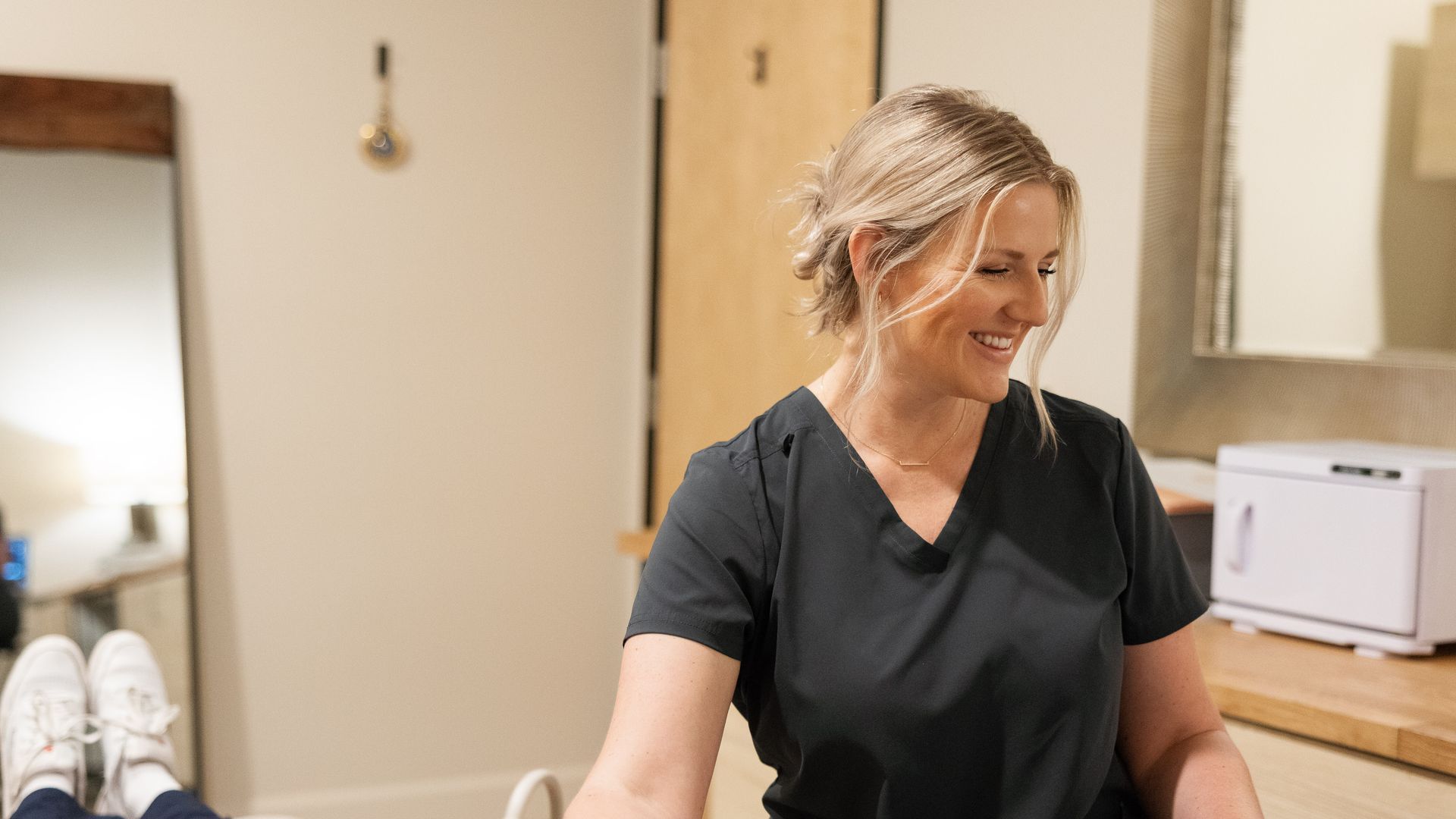
For a stable patient with an isolated limb question, a mobile venous duplex solves several problems at once. The patient does not need to be dressed, transported in compression garments, and seated in a waiting room a few days after surgery. The aftercare nurse or caregiver can remain present. The study is the same complete protocol a hospital vascular lab performs, read by a board-certified radiologist, with the report going to the ordering surgeon or physician.
Practical details that matter for aesthetic patients:
- Garments and dressings. The sonographer needs access to the limb being scanned. Compression garments can usually be loosened or removed for the lower extremity while abdominal binders stay in place. The surgeon should specify anything that must not be disturbed.
- Drains and incisions. Venous studies of the leg do not involve the surgical site, but the order should mention drains or incisions near the groin, as with thigh lifts or liposuction of the inner thighs, so the sonographer plans around them.
- Positioning. Most venous studies are done with the patient lying with the head slightly raised and the leg rotated. Post-op patients who cannot lie flat can usually be scanned semi-reclined.
- Privacy. Aesthetic patients often value discretion. A home, hotel or aftercare visit keeps the recovery private.
Setting up a workflow with aftercare residences
Practices that see a steady flow of post-operative patients benefit from agreeing on the workflow in advance rather than at 6 p.m. on a Friday:
- Define who can place the order. Usually the operating surgeon’s office or the patient’s concierge physician, not the aftercare staff.
- Agree on what goes in the order: procedure and date, Caprini score if known, anticoagulation status, the limb and the clinical question.
- Agree on urgent-finding communication: who receives a call if the radiologist identifies a thrombus, and a backup number.
- Agree on what the patient hears. Many surgeons prefer that only the surgeon’s office discusses results with the patient.
Timing and the written report
A mobile provider may be able to reach the patient the same day, but the written radiologist report follows its own timeline, often within 24 hours. Surgeons sometimes start or adjust anticoagulation while awaiting imaging in selected patients. That is a clinical decision for the operating surgeon or treating physician. If a decision cannot wait for the written report, discuss urgent-finding communication with the imaging provider before the visit.
Patients who will fly home
Many aesthetic patients come to Los Angeles, Beverly Hills or Orange County from out of state and plan to fly home within one to two weeks. Travel after surgery is a known additional risk. Plastic surgery safety guidance encourages surgeons to plan travel timing, mobility and prophylaxis with the patient. If a patient develops symptoms before a planned flight, a duplex before travel gives the surgeon a clearer picture for that decision.
Upper extremity clots after surgery
Leg clots get most of the attention, but arm swelling after surgery deserves the same attention. IV catheters, arm positioning during long procedures and arm liposuction or brachioplasty can all be associated with upper extremity venous thrombosis or superficial thrombophlebitis. One-sided arm swelling, pain or a tender cord near an IV site is a reasonable indication for an upper extremity venous duplex, ordered by the surgeon or treating physician.
Superficial thrombophlebitis
A tender, red, cord-like vein near the skin is common after surgery, especially at old IV sites or in varicose veins. It is often managed conservatively, but superficial thrombosis close to the junction with the deep system, such as near the groin or behind the knee, can extend into the deep veins. Duplex ultrasound measures the clot’s length and its distance from the deep system, which helps the treating physician decide on management.
What the surgeon receives
The radiologist report for a post-operative venous duplex describes each venous segment evaluated, whether it compresses normally and has normal flow, and the location and extent of any thrombus. It also notes findings that might explain symptoms without a clot, such as a hematoma, seroma, enlarged lymph nodes or a Baker’s cyst. The surgeon or treating physician decides on treatment and communicates the plan to the patient and aftercare staff.
Documentation for the surgical record
Practices that order imaging for post-operative patients should file the report in the surgical record, along with the Caprini score, prophylaxis plan and any changes made in response to the result. Clear documentation supports quality review and helps if the patient later sees another clinician, especially out-of-town patients who return home after recovery.
Keeping the patient informed without alarming them
Post-operative patients are often anxious. When a duplex is ordered, a short explanation from the surgeon’s office helps: the scan is a precaution, it takes about 30 to 45 minutes, the sonographer will not discuss results, and the office will call with the plan. Patients who know what to expect are calmer during the visit and less likely to call the aftercare residence repeatedly for updates.
Ordering in Southern California
UltraVision Imaging performs lower and upper extremity venous duplex studies at patients’ homes, hotels and aftercare residences across Los Angeles, including Beverly Hills, West Hollywood and Santa Monica, as well as Orange County and San Diego County. A board-certified radiologist reads every study and the report goes to the ordering surgeon or physician. Call the local line for your region on our page for physicians, or send a referral from any area page. Our team will be in touch to coordinate scheduling.
Frequently asked questions
Can a venous duplex be done while the patient wears compression garments?
The garment over the leg being scanned usually needs to be loosened or removed for the study. Abdominal binders can typically stay in place. The surgeon should note anything that must not be disturbed.
Which aesthetic procedures carry the highest VTE risk?
Published data point to abdominoplasty, combined procedures, longer operative time and body contouring after massive weight loss as higher risk.
Who should order the study?
Usually the operating surgeon’s office or the patient’s concierge physician. The report goes to the ordering physician.
Should a patient with shortness of breath after surgery get a mobile study?
No. Respiratory symptoms may represent pulmonary embolism and need emergency evaluation.
Can you scan patients in aftercare residences and hotels?
Yes. The office or the patient arranges access in advance, and the study is performed in a private room.
Does the sonographer tell the patient the result?
No. The radiologist report goes to the ordering physician, who discusses it with the patient.
Sources
- Murphy RX Jr et al. ASPS Venous Thromboembolism Task Force report. Plast Reconstr Surg 2012
- Pannucci CJ et al. Validation of the Caprini risk assessment model in plastic and reconstructive surgery patients. J Am Coll Surg 2011
- ISAPS: Patient safety update on DVT and PE (2024)
- Lim W et al. ASH 2018 guidelines: diagnosis of venous thromboembolism. Blood Adv 2018
- RadiologyInfo.org (ACR and RSNA): Venous ultrasound
This article is general information for licensed clinicians and practice staff. It is not medical or legal advice and does not replace clinical judgment. UltraVision Imaging performs diagnostic ultrasound; a board-certified radiologist interprets every diagnostic study, and the ordering physician directs care.