
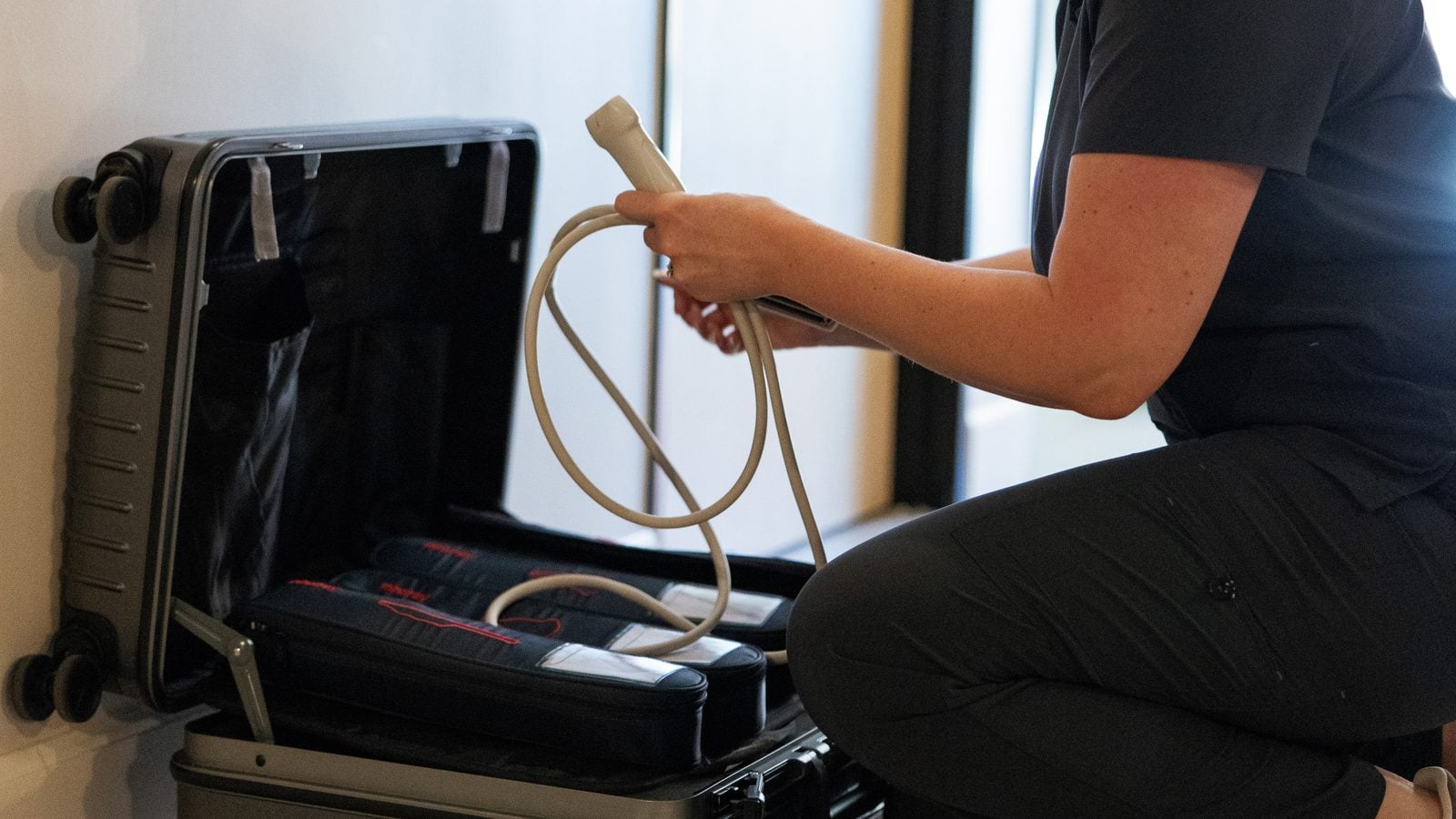
For many families, the hardest part of a parent’s imaging appointment has little to do with the scan. It is the drive, the parking, the wheelchair at the entrance, the wait, and the effort of getting someone who tires easily, or who becomes disoriented in unfamiliar places, through the whole morning. An in-home ultrasound removes the travel. Our sonographer arrives with a portable diagnostic system, performs the same study we perform in our clinic, and a board-certified radiologist reads it.
This guide is for adult children and other family members who are helping a parent arrange a scan at home. It covers when a home visit may make sense, who decides which scan is done, how consent and report access work, what to prepare in the house, how payment works, and, most importantly, which situations call for 911 rather than a scheduled visit.
Our roles are the same in a living room as in a clinic. Our sonographer performs the scan, a board-certified radiologist reads the images and writes the report, and your parent’s own doctor interprets that report in light of their history, medications, labs and symptoms. We never diagnose, and we don’t recommend which scan your parent needs. That is a decision for your parent and their physician.
First: when it’s 911, not a home scan
A home ultrasound is a scheduled diagnostic appointment. It is not urgent care, and we are not an emergency service. If your parent shows any of the signs below, call 911 rather than booking a scan or waiting for one:
- Stroke signs. Cleveland Clinic teaches BE FAST: trouble with balance or coordination, sudden vision changes, drooping on one side of the face, weakness in an arm or leg, slurred speech or trouble understanding, and Time, meaning call 911 right away rather than waiting to see if it passes.
- Sudden leg swelling together with shortness of breath or chest pain. The CDC lists swelling, pain, warmth and redness in a leg or arm as possible signs of a deep vein clot, and difficulty breathing, chest pain that worsens with a deep breath or cough, a fast or irregular heartbeat, coughing up blood, lightheadedness or fainting as possible signs of a clot in the lungs. With the breathing or chest symptoms, the CDC says to seek medical help immediately.
- Severe abdominal or back pain. Mayo Clinic describes sudden, very bad and long-lasting belly or back pain that may feel like ripping or tearing, with low blood pressure and a fast pulse, as signs of a ruptured aortic aneurysm.
- A fall with injury, new confusion, fainting, or any sudden change that worries you.
Leg swelling on its own, without breathing or chest symptoms, is still a reason to contact your parent’s doctor as soon as possible, as the CDC advises. The doctor decides what is needed and how fast. If the doctor wants a vein study, that requires a referral, which is covered below.
When an in-home scan may make sense
Families tend to consider a home visit when getting to an imaging center is itself the obstacle. Common situations include:
- Limited mobility. A parent who uses a walker or wheelchair, has trouble with car transfers, or finds a long walk from the parking area exhausting.
- Cognitive impairment. Some people with memory loss or dementia become anxious or confused in unfamiliar settings, and a familiar room can make a calm exam more likely.
- Recovery after surgery or illness. A period when a car trip is uncomfortable or the surgeon has limited activity.
- Caregiving logistics. An adult child who lives at a distance, works full time, or is coordinating several appointments for one parent.
- Infection concerns or frailty. Some families simply prefer to avoid a waiting room.
None of these make a home scan the right choice automatically. Whether an ultrasound is the right test at all, and which one, is a question for your parent’s doctor. Our post Mobile ultrasound vs hospital vs imaging center compares the settings.
Who decides which scan is done
A scan is done either because your parent’s physician has asked for it or because your parent has chosen it for themselves. Family members help with logistics, but they don’t choose a scan on a parent’s behalf unless they are legally authorized to make healthcare decisions for that parent, a point covered in the next section.
The scans we offer are targeted diagnostic studies. They include abdominal ultrasound (complete or limited), renal ultrasound of the kidneys and bladder, thyroid ultrasound, carotid duplex, AAA screening of the abdominal aorta, DVT vein studies of the legs or arms, pelvic and breast ultrasound, scrotal and prostate ultrasound, and soft tissue ultrasound of a lump, bump or swelling. We do not perform echocardiograms or other heart scans, leg-artery studies, biopsies, injections or blood draws. If your parent’s doctor wants one of those, ask the doctor where it can be done. When you enter your parent’s ZIP code on the booking page, it shows the options and times for that address.
Two of our scans require a referral: DVT vein studies (legs or arms) and the second-trimester anatomy scan. For a parent, the relevant one is usually the DVT study. The referral is uploaded in the booking form, and we confirm it before the visit. Everything else can be booked directly. Our post DVT ultrasound: what to expect explains the vein study.
If your parent is considering a scan without any symptoms, the national screening picture is worth knowing. The USPSTF recommends one-time AAA screening with ultrasound for men 65 to 75 who have ever smoked (grade B), selective screening for men 65 to 75 who have never smoked (C), and recommends against routine screening for women who have never smoked and have no family history (D); for women 65 to 75 who have ever smoked or have a family history, it finds the evidence insufficient (I). It recommends against screening adults without symptoms for carotid artery stenosis and thyroid cancer (both D). Any scan can find incidental findings that lead to more tests. Talk with your parent’s doctor before booking a screening scan.
Consent and decision-making
The patient consents to the scan. If your parent can understand what the exam involves and agree to it, the decision is theirs, even when an adult child has done all the arranging. Our sonographer will explain each step and check that your parent is comfortable before and during the exam, and your parent can ask to pause or stop at any point.
When a parent can no longer make healthcare decisions, someone else may be legally authorized to make them. The National Institute on Aging describes a health care proxy (also called a representative, surrogate or agent) as a person who can make medical decisions for someone who cannot communicate them, often named through a durable power of attorney for health care. It also notes that state requirements vary greatly.
Whether a particular family member holds that authority, and whether it applies right now, is for the family, their legal adviser and the parent’s doctor to confirm. We can’t give legal advice. If someone other than your parent will be giving consent, raise it when you book so we know before the visit, and have the relevant document available.
HIPAA and getting the report
The radiologist’s report goes to the patient and to the doctor named on the booking form. A family member’s access to that report depends on the patient’s authorization, or on being the patient’s legal personal representative.
HHS explains that under HIPAA, a personal representative can generally access a person’s health information, and that if someone can make healthcare decisions for a person under a health care power of attorney, that person is the personal representative. HHS also notes that state law may affect this. Separately, HHS guidance on family members and friends says the Privacy Rule does not require a provider to share information with family or friends who are not personal representatives, though a provider may share relevant information with people involved in a patient’s care when the patient agrees or does not object.
In practice, the cleanest arrangement is for your parent to authorize your access in advance. Ask us how to set that up when you book, so it is in place before the report is ready. Many families also ask the parent’s doctor’s office how they share results with family, since the doctor is the person who will explain the report.
Booking on a parent’s behalf
You can book online on our booking page. Enter your parent’s ZIP code, choose the scan and pick a time. Make sure the patient details are your parent’s, and that the doctor named on the form is your parent’s doctor, since that is who will receive the report. If your parent doesn’t have a doctor to name, the form accepts “None,” though a doctor to review the report is strongly worth arranging. There is an optional referral upload, which is required for DVT studies. Referrals are uploaded in the form only.
It helps to have these ready when you book:
- Your parent’s full name, date of birth and the address where the scan will take place.
- The name of the doctor who should receive the report.
- The referral, if the scan needs one or your parent’s doctor wrote one.
- Any practical notes for the visit: stairs, a gate code, where to park, or a parent who hears better on one side.
Preparing the home and the patient
A home visit asks very little of the space. A few minutes of preparation make the exam smoother:
- Somewhere to lie down with room for the sonographer at one side: a bed is usually best, a couch also works. If your parent uses a hospital bed, that is ideal.
- A standard outlet within reach of the bed or couch.
- A quiet room, with the television off and pets settled in another room.
- Loose, two-piece clothing. A top that lifts easily for abdominal or kidney scans, and an open neckline for thyroid or carotid scans.
- A current medication list and any recent reports from earlier imaging, which can help the radiologist compare.
- A familiar person nearby if your parent finds that reassuring. Your parent chooses who is in the room.
Prep depends on the scan. Follow the instructions in your confirmation; these are our standard rules:
| Scan | Prep |
|---|---|
| Complete or limited abdominal, AAA screening | Nothing to eat for 8 hours; water and regular medications are fine |
| Renal (kidneys and bladder), prostate, pelvic transabdominal | Full bladder: 32 oz of water finished an hour before; don’t empty |
| Thyroid | No prep; open neckline |
| Breast | No lotion, powder or deodorant |
Fasting and drinking a large amount of water can both be harder for older adults. If your parent has diabetes, ask the doctor who manages it how to handle medication while fasting. If your parent’s fluid intake is restricted, or a full bladder would be difficult, ask their doctor before the visit, and tell us when you book. Our guide How to prepare for an ultrasound explains the reasons behind each rule.
What our sonographer brings and how long it takes
Our ARDMS-registered sonographer brings a portable diagnostic ultrasound system, the transducers needed for the study, gel and exam supplies. Ultrasound uses sound waves, not radiation; RadiologyInfo describes it as safe and noninvasive, and notes that an exam may occasionally be temporarily uncomfortable but should not be painful. There are no needles.
The visit begins with a short check-in: confirming your parent’s name and date of birth, the scan booked, and a few questions about the area being scanned. The sonographer then applies gel and moves the transducer over the skin. Your parent may be asked to roll slightly, take a breath and hold it, or lift an arm, and the sonographer can adapt positioning for someone with limited movement. Your confirmation shows the appointment window, which includes setup and packing up. Our post What happens at a home ultrasound visit walks through the visit step by step.
Assisted living and care facilities
If your parent lives in assisted living, memory care or another care facility, the facility’s own rules apply. Many have policies about outside providers, visiting hours, sign-in, and whether staff need to be notified or present. Check with the facility before you book, and tell us about anything we should know, such as a check-in desk or a preferred time of day. If the facility has its own clinical team, it can be helpful to let them know a scan is planned.
Paying for the scan
Payment is a flat rate paid when you book, with no facility fee. HSA and FSA cards are accepted. We don’t bill insurance, including Medicare. A superbill is available, and you can ask your parent’s plan whether it offers any reimbursement. Our posts on superbills and using an HSA or FSA explain the basics.
After the visit: results and next steps
Our sonographer won’t give results at the visit, even to a worried family member; our post Why won’t the sonographer tell me what they see? explains why. A board-certified radiologist reads every study, and the report is ready within 24 hours. It goes to your parent and to the doctor named on the booking form.
The doctor is the person who explains what the report means for your parent and what, if anything, comes next. Our post What does my ultrasound report mean? explains how reports are organized, but it can’t interpret one. Questions families often bring to the follow-up conversation:
- What did the report find, and how does it fit with my parent’s history and medications?
- Does anything in the report need follow-up, and how soon?
- If more tests are suggested, can any of them be done at home, and which need a facility?
- Is there anything we should watch for at home, and when should we call you or 911?
- Who should we contact if new symptoms appear before the next appointment?
Sources
- HHS: Personal Representatives (HIPAA for Individuals)
- HHS: Family Members and Friends (HIPAA for Individuals)
- National Institute on Aging: Choosing a Health Care Proxy
- Cleveland Clinic: Signs of a Stroke, Act Quickly With BE FAST
- CDC: About Venous Thromboembolism (Blood Clots)
- Mayo Clinic: Abdominal aortic aneurysm, symptoms and causes
- RadiologyInfo.org: General Ultrasound
- USPSTF: Abdominal Aortic Aneurysm: Screening (2019)
- USPSTF: Asymptomatic Carotid Artery Stenosis: Screening (2021)
- USPSTF: Thyroid Cancer: Screening (2017)
Frequently asked questions
Can I book a home ultrasound for my parent?
Yes, you can help arrange it online, but the scan must be one your parent’s doctor has asked for or one your parent chooses for themselves, and your parent consents to it. Enter your parent’s details as the patient and name their doctor on the booking form so the report goes to the right physician.
Does my parent need a referral for a home ultrasound?
Only for DVT vein studies of the legs or arms (and the second-trimester anatomy scan, which rarely applies). The referral is uploaded in the booking form, and we confirm it before the visit. Other scans can be booked directly, and the form has an optional referral upload.
Can I get a copy of my parent’s ultrasound report?
The report goes to the patient and to the doctor named on the booking form. A family member’s access depends on the patient’s authorization or on being their legal personal representative under HIPAA. Ask us how to set up that authorization when you book, so it is in place before the report is ready.
What if my parent can’t make their own healthcare decisions?
Someone else may be legally authorized to decide for them, often a health care agent named in a durable power of attorney for health care. Whether that applies is for the family, their legal adviser and the parent’s doctor to confirm; we can’t give legal advice. Tell us when you book if someone other than your parent will be giving consent.
Does Medicare cover a home ultrasound with you?
We don’t bill insurance, including Medicare. Payment is a flat rate paid when you book, with no facility fee, and HSA and FSA cards are accepted. A superbill is available, and you can ask your parent’s plan whether it offers any reimbursement.
When should we call 911 instead of booking a scan?
Call 911 for stroke signs (BE FAST: balance, eyes, face, arms, speech, time), sudden leg swelling with shortness of breath or chest pain, sudden severe abdominal or back pain, a fall with injury, new confusion, fainting or any sudden change that worries you. A home ultrasound is a scheduled diagnostic visit, not an emergency service.
This article is general health information, not medical advice. It does not replace a conversation with your own physician, who knows your history and can interpret results in context. If you have symptoms that worry you, contact your doctor; if you think you are having a medical emergency, call 911.