
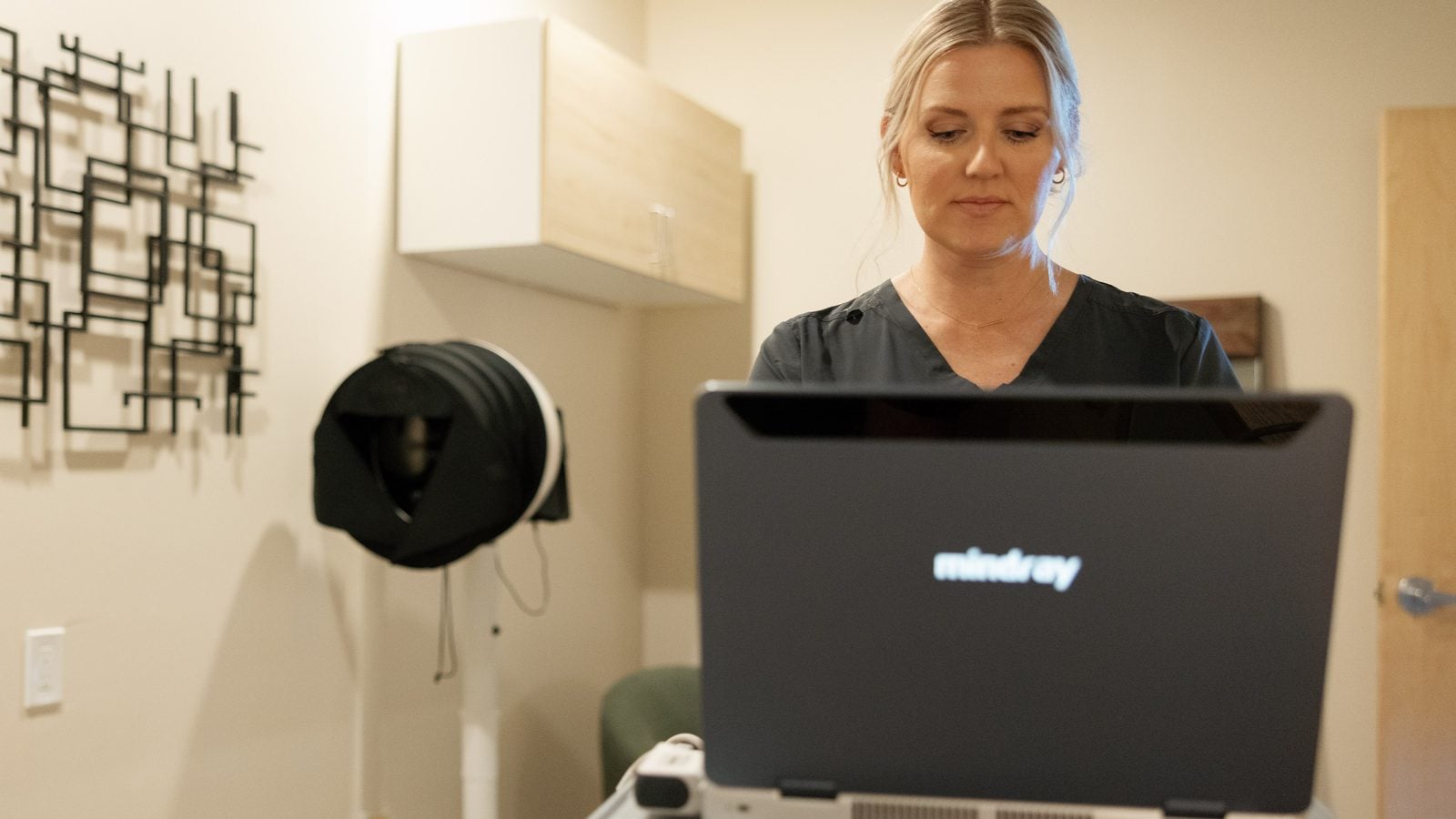
If you’ve been told you need a transvaginal ultrasound, or you’re considering one, it’s natural to wonder whether it will hurt. The short answer from major medical sources is that it usually doesn’t. Most people describe pressure or mild discomfort rather than pain, and the internal part is often over in a few minutes. But “usually” isn’t “always,” and some people do find it harder. This guide explains what the probe is, what the exam typically feels like according to RadiologyInfo, Cleveland Clinic and the NHS, why it can be more uncomfortable for some people, and what choices you have, including stopping at any time or choosing a transabdominal-only scan instead.
One thing to say plainly up front: this article is about the experience of the exam, not about what any result means. Our sonographer performs the scan, a board-certified radiologist reads the images and writes the report, and your own physician interprets that report for you. We never diagnose.
When to go to the ER or call 911 instead
A scheduled ultrasound is not emergency care. Go to the nearest emergency department or call 911 if you have:
- Sudden, severe pain in the lower belly or pelvis.
- Heavy vaginal bleeding, especially with dizziness or weakness.
- Severe lightheadedness, fainting or unusual paleness with pelvic pain.
- Any bleeding or pain in pregnancy that worries you. The NHS lists a sudden, sharp, intense pain in the lower belly together with severe lightheadedness or passing out, nausea or unusual paleness as signs that need emergency care in early pregnancy.
- Pelvic pain with a high fever or vomiting that won’t stop.
If symptoms are new but not severe, call your doctor or OB the same day. Don’t wait for a booked scan.
What the probe is and how it’s used
A transvaginal ultrasound uses a slim probe, called a transducer, placed a short way into the vagina. Because the probe sits closer to the uterus and ovaries than a probe on the belly, it can often show these organs in more detail. That’s why it’s commonly used for things like checking the uterine lining, looking at the ovaries, follicle checks during fertility care, and early pregnancy scans.
Some useful facts about the probe and the process:
- Size. Cleveland Clinic describes the probe as rounded at the top and less than 1.5 inches in diameter, and says it may feel like a larger-than-normal tampon. RadiologyInfo notes that the tip is smaller than the standard speculum used for a Pap test.
- Cover and gel. The probe is covered with a protective sheath and lubricating gel before it’s inserted. The gel may feel cool.
- Latex. The NHS notes that probe covers may contain latex and that you should tell staff if you have a latex allergy so an alternative can be used. Please mention a latex allergy when you book and again at the visit.
- Movement. The probe is moved and angled gently to see each structure. It isn’t pushed deep; it stays in the vagina, not the cervix or uterus.
- Safety. Ultrasound uses sound waves, not radiation. Cleveland Clinic notes the test is safe, including during pregnancy. More in is ultrasound safe?
What it usually feels like
Here’s how several respected sources describe the sensation, in their own words:
| Source | What it says about how it feels |
|---|---|
| RadiologyInfo (ACR/RSNA) | The sonogram “should not be painful or significantly increase your discomfort,” and a vaginal sonogram is usually more comfortable than a manual gynecologic exam. |
| Cleveland Clinic | The test “shouldn’t be painful,” though it “may be uncomfortable.” You might feel some pressure or mild discomfort that “usually goes away quickly.” |
| NHS | Internal probes “can be uncomfortable when they’re put inside your body or moved during the test.” Lubricant is used to make it more comfortable, and you can tell the person doing the scan if it hurts. |
| Guy’s and St Thomas’ (NHS) | It is similar to having a smear test, “but it should not be as uncomfortable.” |
| University Hospitals Sussex (NHS) | “Well tolerated by the majority of our patients”; slight discomfort can often be eased by relaxing the pelvic muscles. |
Put together, the common experience is: a cool feeling from the gel, a sense of fullness or pressure as the probe goes in, and pressure that shifts as it’s angled. Some people notice more pressure when the probe is turned toward one side to look at an ovary. Cleveland Clinic gives a typical exam time of 15 to 30 minutes, and Guy’s and St Thomas’ notes the internal part itself often takes just a few minutes.
Pain during a scan is information worth sharing. If something hurts, say so right away. The sonographer can adjust the angle or pressure, pause, or stop. If a particular spot was tender during the scan, it’s also worth mentioning to your own doctor afterward, because your physician is the one who puts the scan, your symptoms and your history together.
When it may be more uncomfortable
Some people find the exam harder than average. This is common and nothing to be embarrassed about. Situations that can make it more uncomfortable include:
- Existing pelvic pain. If you already have pelvic pain, pressure from the probe may be felt more. Guy’s and St Thomas’ notes that pain isn’t expected unless you already have symptoms causing it.
- Pain with penetration or vaginismus. The NHS describes vaginismus as the vagina suddenly tightening when you try to insert something, an automatic reaction you can’t control, and notes it can happen with tampons or during cervical screening. If insertion of anything is difficult or painful for you, a transvaginal scan may be too, and you have options (see below).
- After menopause. Cleveland Clinic describes genitourinary syndrome of menopause (also called vaginal atrophy) as drying and thinning of the vaginal lining from lower estrogen, and says at least half of women entering menopause show signs of it. Dryness can make insertion feel less comfortable. Extra gel and going slowly can help, so let the sonographer know.
- Never having had anything inserted, or past difficult exams. Anxiety tenses the pelvic muscles, which can make insertion feel harder. Telling the sonographer helps them go at your pace.
- Past trauma. If internal exams are distressing for you, you are entitled to decline, pause or stop, and to choose a transabdominal-only scan.
These are general situations, not an explanation of your own experience. If you regularly have pain with exams, tampons or sex, that’s worth raising with your doctor, who can look into it with you.
Your choices: you’re in control
The NHS puts it simply: “You’re in control of the scan and can ask the person doing your scan to stop at any time.” At our practice, the transvaginal part is always your choice, done only with your consent, and you can stop it at any time. Here are the options worth knowing about:
- Stop or pause at any time. Just say so. You don’t need to give a reason.
- Ask to insert the probe yourself. The NHS says you can ask to insert the probe yourself, and Henry Ford Health notes that patients may be asked to insert it “as you would a tampon.” Whether this is offered depends on the facility, so ask at the start of the visit.
- Ask for more gel and a slower pace. This is especially helpful after menopause or if you’re tense.
- Choose a transabdominal-only scan. We offer a pelvic ultrasound done entirely over the belly, for kids and teens or when an internal scan isn’t wanted. Patients under 18 have transabdominal scans only.
It’s fair to know the trade-off. A transabdominal scan views the pelvis through the belly wall and a full bladder, so some details can be harder to see than with a transvaginal view. University Hospitals Sussex notes that an abdominal scan “may not provide us with enough information” in some cases. That doesn’t make it the wrong choice; it means it’s worth asking your doctor whether the question they’re trying to answer can be addressed with a transabdominal scan. Our post on transabdominal vs transvaginal pelvic ultrasound explains the differences.
Practical tips to make it more comfortable
- Empty your bladder before the transvaginal part. A full bladder is needed for the transabdominal part of a combined scan, but for the transvaginal part an empty bladder is more comfortable and gives a better view.
- Wear easy clothing. A two-piece outfit means you only need to undress from the waist down. You’ll have a sheet or gown for cover.
- Tell the sonographer what you need. Nervousness, past discomfort, menopause, a latex allergy, or wanting to insert the probe yourself are all useful to share at the start.
- Breathe slowly and let your pelvic muscles relax. University Hospitals Sussex notes that relaxing these muscles can help avoid slight discomfort. A slow breath out as the probe goes in can help.
- Ask what’s happening. Knowing when the probe will move can make pressure feel less surprising. Keep in mind the sonographer can explain the steps but doesn’t give results at the visit; here’s why the sonographer won’t tell you what they see.
- Know you can stop. Many people find the exam easier simply knowing they can end it whenever they want.
Afterward, a little leftover gel is normal. If you have significant pain or bleeding after the scan that doesn’t settle, contact your doctor, and use the emergency guidance above if it’s severe.
Prep by scan type
| Scan | Prep |
|---|---|
| Pelvic ultrasound with transvaginal (combined) | Full bladder for the first, transabdominal part (32 oz of water finished an hour before; don’t empty). Then you empty your bladder before the transvaginal part. |
| Pelvic ultrasound, transabdominal only | Full bladder: 32 oz of water finished an hour before. Don’t empty. |
| Transvaginal-only scans, such as follicular monitoring or a lining check | Empty bladder. |
| OB first trimester (6 to 13 weeks) | Full bladder: 32 oz of water finished an hour before. Don’t empty. |
Tips on drinking enough without discomfort are in how to fill your bladder before a pelvic ultrasound, and our ultrasound prep guide covers every scan.
Questions to ask your doctor before the scan
- What question is this scan meant to answer?
- Is a transvaginal view needed, or could a transabdominal-only scan answer it?
- Should I time the scan to a particular day of my cycle?
- I find internal exams painful. Is that something we should look into separately?
- When will we go over the report together?
Getting a pelvic ultrasound with us
You can come to our clinic, or we bring the scan to you at home across our California service areas with a portable diagnostic system. Our women’s health ultrasound page lists the options, and what happens during a pelvic ultrasound walks through the visit.
- Booking: book online at our booking page. No referral is needed for pelvic scans. The form asks for the doctor who should receive the report (type “None” if you don’t have one), and there’s an optional referral upload.
- Your choice: pick the pelvic ultrasound with transvaginal, or the transabdominal-only pelvic ultrasound if you don’t want an internal scan. Even if you book the combined scan, the transvaginal part is always your choice and can be stopped at any time.
- Results: the sonographer does not give results at the visit. A board-certified radiologist reads every diagnostic study, and the report is ready within 24 hours. It goes to you and to the doctor you named, who interprets it for you. Our guide to reading an ultrasound report explains common terms in general.
- Payment: a flat rate paid when you book, no facility fee, HSA/FSA accepted. We don’t bill insurance, and a superbill is available.
Sources
- RadiologyInfo (ACR/RSNA): Ultrasound, Pelvis
- Cleveland Clinic: Transvaginal Ultrasound
- NHS: Ultrasound scan
- Guy’s and St Thomas’ NHS Foundation Trust: Transvaginal ultrasound scan
- University Hospitals Sussex NHS Foundation Trust: Transvaginal ultrasound examination
- Henry Ford Health: Transvaginal Ultrasound
- NHS: Vaginismus
- Cleveland Clinic: Vaginal Atrophy (Genitourinary Syndrome of Menopause)
- NHS: Ectopic pregnancy
Frequently asked questions
Does a transvaginal ultrasound hurt?
For most people it doesn’t. RadiologyInfo, Cleveland Clinic and the NHS describe pressure or mild discomfort rather than pain, which usually passes quickly. Some people find it more uncomfortable, and you can tell the sonographer, pause or stop at any time.
How big is the transvaginal probe?
Cleveland Clinic describes it as less than 1.5 inches in diameter and rounded at the top, and says it may feel like a larger-than-normal tampon. RadiologyInfo notes the tip is smaller than a standard speculum used for a Pap test.
Can I insert the probe myself?
The NHS says you can ask to insert the probe yourself, and some facilities offer this. Whether it’s available depends on the facility, so ask at the start of your visit.
Can I stop the scan or choose not to have the internal part?
Yes. The transvaginal part is always your choice and can be stopped at any time. We also offer a pelvic ultrasound done only over the belly. It may show less detail in some cases, so ask your doctor whether it can answer their question.
Should my bladder be full or empty for a transvaginal ultrasound?
Empty for the transvaginal part. For a combined scan, you start with a full bladder (32 oz of water finished an hour before) for the transabdominal part, then empty your bladder before the transvaginal part. Transvaginal-only scans, such as follicle or lining checks, need an empty bladder.
Is a transvaginal ultrasound harder after menopause?
It can be for some people. Cleveland Clinic notes that lower estrogen after menopause can make the vaginal lining drier and thinner, which may make insertion less comfortable. Let the sonographer know so they can use more gel and go slowly, and raise any ongoing discomfort with your doctor.
This article is general health information, not medical advice. It does not replace a conversation with your own physician, who knows your history and can interpret results in context. If you have symptoms that worry you, contact your doctor; if you think you are having a medical emergency, call 911.