
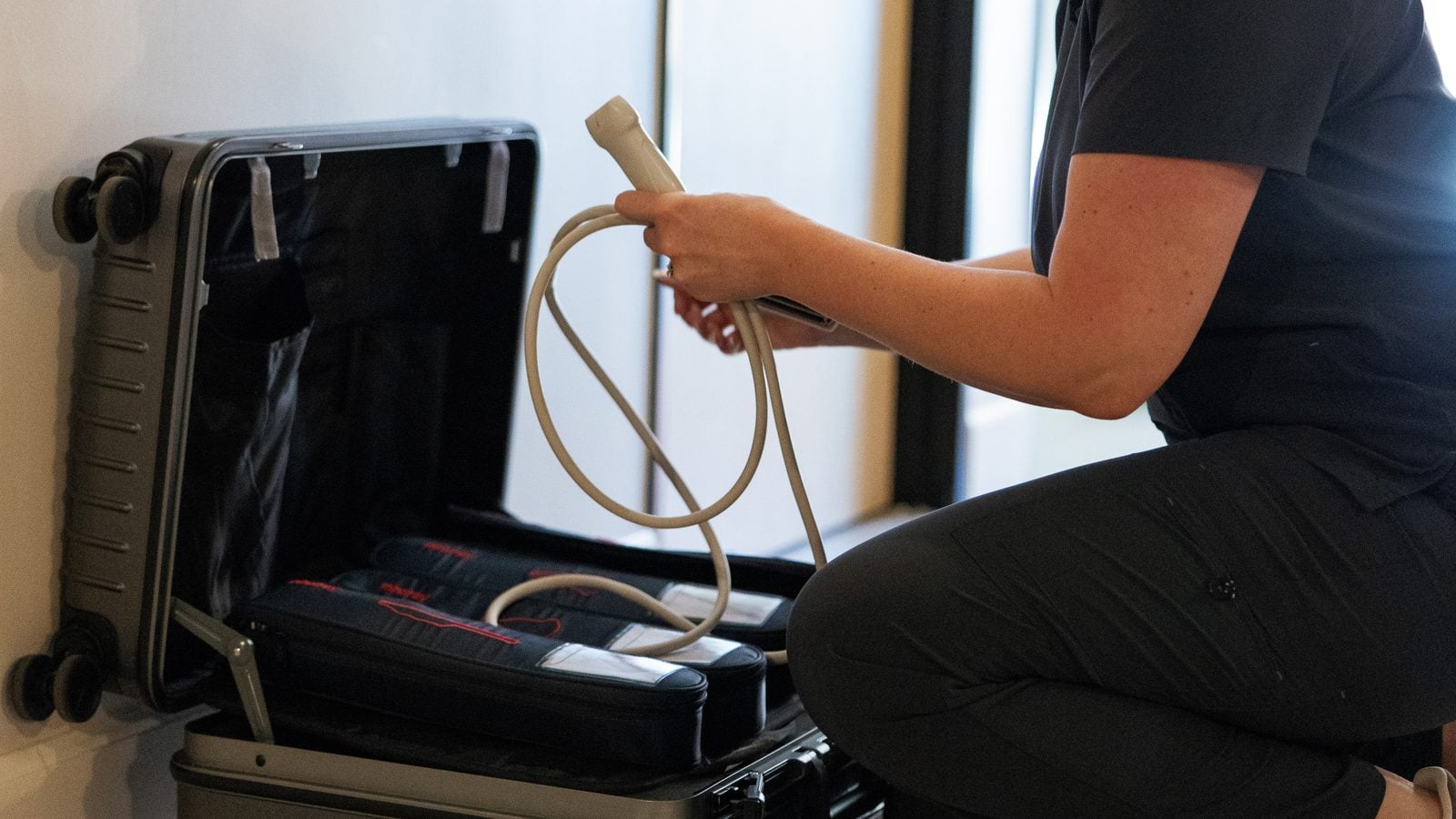
A mobile ultrasound sounds simple: a sonographer arrives with a portable machine, you lie down on your own couch or bed, and the scan is done without a drive or a waiting room. For many people, that is exactly what it is. But “mobile ultrasound” covers a wide range of businesses, from diagnostic imaging services with a radiologist behind every study to keepsake operations with no physician involved at all. From the outside, they can look alike.
This guide gives you ten questions to ask before anyone brings an ultrasound machine to your door. They work for any provider, including us. Each one explains why it matters and what a good answer sounds like, with sources from the organizations that set the standards.
First, a word on roles, because it is the foundation of every good answer below. We never diagnose. Our sonographer performs the scan, a board-certified radiologist reads the images and writes the report, and your own physician interprets that report for you, in the context of your history, labs and symptoms. A good mobile provider will describe the same division of labor without being asked.
Question 1: Is the sonographer credentialed, and by whom?
Sonography is a skilled, hands-on job. The quality of a scan depends heavily on the person holding the transducer, because they decide which images are captured and how. Ask what credential the sonographer holds.
The most widely recognized credentials in the United States come from two organizations:
- ARDMS (the American Registry for Diagnostic Medical Sonography) awards the RDMS (Registered Diagnostic Medical Sonographer), with specialty exams such as abdomen, breast and OB/GYN; the RVT (Registered Vascular Technologist); the RDCS for cardiac sonography; and others. Earning the RDMS requires passing a physics exam (Sonography Principles and Instrumentation) plus a specialty exam. ARDMS describes its credentials as voluntary: no one has to be certified, and those who are have chosen to pass a rigorous examination. ARDMS certification can be checked through the Inteleos verification directory.
- CCI (Cardiovascular Credentialing International) awards vascular and cardiac credentials, including the RVS (Registered Vascular Specialist), whose exam covers areas such as venous, arterial and extracranial studies.
A good answer names the credential and matches it to the scan. Someone doing your carotid study should have vascular training; someone doing an OB scan should have OB/GYN training. It is perfectly reasonable to ask, and a confident provider will not mind. Your doctor can also tell you whether a particular study calls for a particular specialty.
Question 2: Who reads the images?
This is the single most important question. Ultrasound images are not self-explanatory; they have to be interpreted by a physician. RadiologyInfo, the patient site of the American College of Radiology and the Radiological Society of North America, describes the radiologist as the doctor trained to supervise and interpret radiology exams, who analyzes the images and sends a signed report.
Ask whether a board-certified radiologist reads every study. If the answer is that the sonographer will “let you know what they see,” or that no report is provided, the service is not diagnostic. With us, a board-certified radiologist reads every diagnostic study. Our post on why the sonographer won’t tell you what they see explains why results are not given at the visit.
Question 3: How fast is the report, and where does it go?
Ask for a specific turnaround time, not “soon.” Ours is within 24 hours. Then ask where the report goes. A report helps most when it reaches the doctor who will act on it. We send it to you and to the doctor you name when you book. If you do not have a doctor, you can type “None” and you will still receive the report, but we would encourage you to share it with a physician, who can explain what it means for you.
Once you have it, our guide on what an ultrasound report means can help you prepare questions. The interpretation itself is a conversation for your physician.
Question 4: What equipment will you bring?
Portable ultrasound has come a long way. Modern portable systems can produce diagnostic-quality images for many exams, but not every portable device is a diagnostic system, and not every device is used for a diagnostic purpose.
Ask what system will be used and whether it has the right transducers for your exam. Abdominal, pelvic, vascular, thyroid and breast studies typically use different probes and settings. A diagnostic provider should be able to tell you this plainly.
It also helps to know the regulators’ view of non-medical use. The U.S. Food and Drug Administration says ultrasound is generally considered safe when used prudently by appropriately trained health care providers, that providers should follow the ALARA principle (exposure “as low as reasonably achievable”), and that using ultrasound solely for non-medical purposes, such as fetal “keepsake” videos, has been discouraged. The FDA also says over-the-counter fetal heartbeat monitors should only be used by trained health care providers when medically necessary. A service whose main product is keepsake imaging is a different thing from a diagnostic study, even if the machine looks similar. Our post is ultrasound safe covers safety in more depth.
Question 5: How do you protect my health information?
A home visit means your health information travels: booking details, images, the report and messages. Ask how the provider handles that. Most health care providers are covered by HIPAA, the federal health privacy law. The U.S. Department of Health and Human Services explains that under HIPAA patients have the right to see and get a copy of your health records, to receive a notice explaining how your information may be used and shared, and to file a complaint if your rights are denied.
A good answer covers a notice of privacy practices, secure storage of images and reports, and secure delivery of the report to you and your doctor. Ask, too, how you can get copies of your images and report later. Be cautious with any service that seems unclear about privacy or treats it as an afterthought.
Question 6: What happens if something urgent shows up?
A mobile ultrasound service is a scheduled appointment, not an emergency service. Still, sometimes a scan shows something that needs prompt attention. Ask the provider what their process is.
American College of Radiology guidance on communicating imaging findings says that when a finding is urgent or unexpected and significant, the interpreting physician should expedite communication, usually by phone or in person to the referring or treating provider. It encourages radiologists to ask self-referred patients to name a licensed provider who will receive results and oversee follow-up, and notes it may be appropriate to contact the patient directly when the provider cannot be reached. That is one reason our booking form asks for the name of the doctor who should receive the report.
A good answer sounds like this: the radiologist contacts the named doctor, and the patient where appropriate, and the provider is clear that it does not offer emergency care. A provider who promises to handle emergencies at home is promising something no mobile service should.
Question 7: How do you clean the equipment between patients?
Ultrasound transducers touch skin and, for internal exams, the inside of the body. The AIUM’s 2025 guidelines on cleaning and preparing transducers say adequate transducer preparation is mandatory to protect patients from infection. Their main points:
| Transducer type | Examples | What AIUM guidance calls for between patients |
|---|---|---|
| External, on intact skin | Abdominal, thyroid, breast, carotid | Remove gel, clean, then low-level disinfection |
| External, on non-intact skin | Over a wound or broken skin | Low-level disinfection plus a single-use transducer cover |
| Internal | Transvaginal | High-level disinfection, plus a single-use probe cover for each exam when feasible |
The same guidance covers gel: single-use packets where infection is a concern, and multi-use bottles that are never refilled and are discarded when empty. You do not need to memorize this. Simply ask how probes are cleaned between patients, especially for internal exams, and listen for “high-level disinfection” and “probe cover.”
Question 8: Which scans can you do at home, and which can’t you?
A mobile service can perform many routine diagnostic studies well at home. Some studies, though, belong in a hospital or a specialized center: anything needing contrast agents, imaging-guided procedures such as biopsies or injections, sedation, or tests that use other equipment such as CT, MRI or echocardiography. Urgent problems belong in an emergency department, where treatment is available on the spot.
Ask the provider for a clear list of what they offer and what they don’t. Here is ours, from our live booking page:
| Area | Scans we offer |
|---|---|
| Abdomen and kidneys | Complete abdominal, limited abdominal (one area), renal (kidneys and bladder) |
| Thyroid | Thyroid ultrasound |
| Vascular | Carotid duplex with CIMT, AAA screening, DVT leg or arm veins (referral required) |
| Women’s health | Pelvic with transvaginal, pelvic transabdominal only, breast, follicular monitoring |
| Men’s health | Scrotal, prostate (scanned over the belly) |
| Other | Soft tissue (a lump, bump or swelling) |
| Pregnancy | First trimester (6 to 13 weeks), growth scan, anatomy scan 19 to 24 weeks (referral required), elective heartbeat & gender visit (non-diagnostic, no report) |
We do not offer leg-artery studies, echocardiograms or heart scans, NT or genetic screening, biopsies, injections, saline sonograms or blood draws. If your doctor has recommended one of those, ask them where to have it done. A provider who says they can do “anything” deserves a follow-up question.
Question 9: Is the price clear and complete before I book?
Ask for one price that covers everything: the scan, the radiologist read and the report. Ask whether there is a facility fee, a separate radiologist bill or a travel fee, and how payment works. With us, you pay a flat rate when you book. There is no facility fee, and HSA and FSA cards are accepted.
If you hope to submit to insurance yourself, ask whether a superbill is available. We don’t bill insurance, but a superbill is available. Our post what is a superbill explains how out-of-network claims work. Federal No Surprises Act rules also mean that, in most cases, uninsured or self-pay patients can get a good faith estimate of costs before care, according to CMS.
Question 10: Do I need a referral, and how do I send it?
Ask which scans need a referral and exactly how to provide one. With us, most scans can be booked directly with no referral needed. Two require one: DVT vein studies (leg or arm) and the second-trimester anatomy scan. For those, you book online and upload the referral in the booking form, and we confirm it before the visit. Referrals are accepted through the booking form upload only. More detail is in do you need a referral for an ultrasound.
Even when no referral is needed, a quick conversation with your doctor about which scan fits your question is worthwhile.
A quick checklist to keep beside the phone
- Sonographer credential named (ARDMS or CCI) and matched to the scan
- A board-certified radiologist reads every diagnostic study
- A specific report turnaround, and the report goes to you and your doctor
- A diagnostic portable system with the right transducers
- A notice of privacy practices and secure report delivery
- A clear process for urgent findings, and honesty that it is not an emergency service
- Transducer cleaning between patients, with high-level disinfection for internal probes
- A clear list of what they do and do not offer
- One all-in price before you book
- Clear referral rules and a secure way to provide one
When a mobile scan is the wrong choice: call 911
No mobile ultrasound service should be used for symptoms that could be an emergency. Call 911 or go to the nearest emergency department for chest pain or sudden shortness of breath; signs of a stroke such as face drooping, arm weakness or trouble speaking; sudden severe or tearing abdominal or back pain; heavy bleeding or severe pain in pregnancy; sudden severe testicular pain; or rapid neck swelling or trouble breathing or swallowing. If you are unsure, call your doctor or a nurse line, or go and be seen.
Getting your scan with us
Start on our booking page. Choose your scan, then a visit at our clinic or a home visit where we bring the scan to you across our California service areas with a portable diagnostic system. You pay the flat rate when you book, with no facility fee, and HSA/FSA is accepted. The form asks for the doctor who should receive the report (“None” is accepted) and has an optional referral upload, required for DVT and anatomy scans.
Prep depends on the scan: nothing to eat for 8 hours for abdominal and AAA studies (water and regular medications are fine); a full bladder for kidney, prostate, transabdominal pelvic and first-trimester scans (32 oz of water finished an hour before, without emptying); and no prep for thyroid beyond an open neckline. See how to prepare for an ultrasound for the full list, and what happens at a home ultrasound visit for the visit itself. Our sonographer does not give results at the visit. A board-certified radiologist reads the study, and the report is ready within 24 hours, sent to you and your named doctor. Then talk it through with your own physician.
Sources
- ARDMS: Information for the public
- ARDMS: RDMS, Registered Diagnostic Medical Sonographer
- Inteleos (ARDMS): Verify certification
- Cardiovascular Credentialing International: Registered Vascular Specialist
- RadiologyInfo.org (ACR and RSNA): General ultrasound
- U.S. Food and Drug Administration: Ultrasound imaging
- U.S. Department of Health and Human Services: Your rights under HIPAA
- American College of Radiology: Practice parameter for communication of diagnostic imaging findings
- AIUM: Guidelines for cleaning and preparing external- and internal-use ultrasound transducers (2025 revision)
- CMS: No Surprises, understand your rights against surprise medical bills
Frequently asked questions
What credentials should a mobile sonographer have?
Look for a credential from ARDMS, such as RDMS with the relevant specialty (abdomen, breast or OB/GYN) or RVT for vascular work, or a vascular credential from CCI such as RVS. Certification is voluntary but requires passing rigorous exams, and ARDMS certification can be checked through the Inteleos verification directory.
Is a mobile ultrasound as accurate as one in a hospital?
For many routine studies, a diagnostic portable system in skilled hands can produce diagnostic-quality images, and the same kind of radiologist reads them. Hospitals add on-the-spot treatment and other tests such as CT and MRI, which is why urgent problems belong there. Your doctor can tell you which setting suits your question.
Who reads the images from a mobile ultrasound?
It depends on the provider, so ask. With us, a board-certified radiologist reads every diagnostic study and the report is ready within 24 hours, sent to you and the doctor you named. Keepsake services often have no physician review and no report.
What happens if the scan shows something urgent?
Radiology guidance calls for urgent findings to be communicated promptly, usually to the named or referring doctor, and sometimes directly to the patient. That is why we ask for your doctor’s name when you book. A mobile service is not an emergency service; for emergency symptoms, call 911.
How are ultrasound probes cleaned between home visits?
AIUM guidelines call for cleaning and low-level disinfection of external probes between patients, and high-level disinfection of internal probes such as transvaginal transducers, with a single-use probe cover for each exam when feasible. It is reasonable to ask any provider how they follow this.
Which scans can’t be done at home?
Studies that need contrast, imaging-guided procedures such as biopsies or injections, sedation, or other equipment such as CT, MRI or echocardiography belong in a hospital or specialized center, as does anything urgent. We do not offer leg-artery studies, echocardiograms, biopsies, injections or blood draws; ask your doctor where to have those.
This article is general health information, not medical advice. It does not replace a conversation with your own physician, who knows your history and can interpret results in context. If you have symptoms that worry you, contact your doctor; if you think you are having a medical emergency, call 911.