
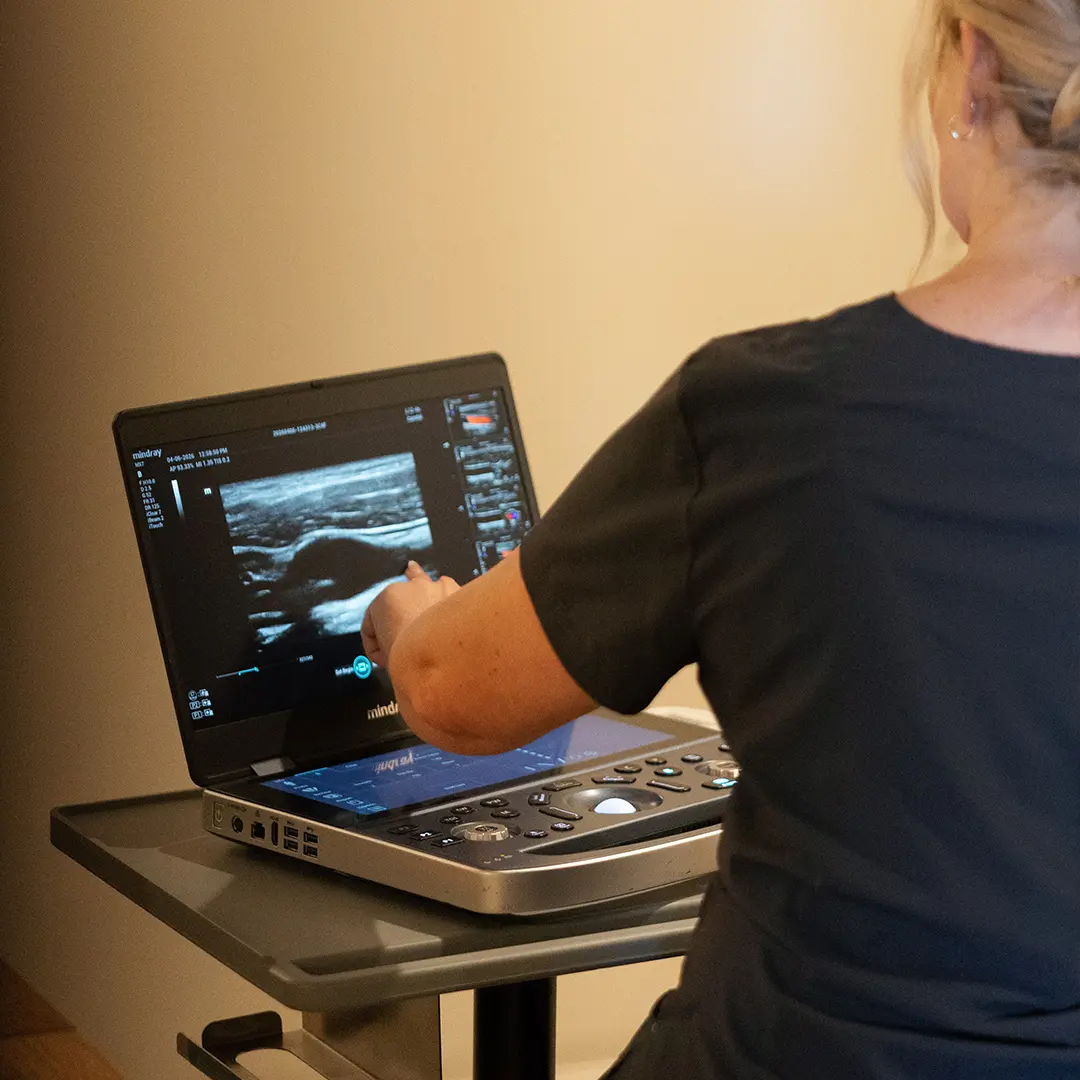
Finding a lump in your breast is frightening, and the waiting is often the worst part. The most useful thing to know first: most breast lumps are not cancer. Cysts, fibroadenomas and normal lumpy breast tissue account for the large majority of lumps people find. But every new lump deserves to be checked, and ultrasound is usually one of the first and most helpful tests.
This guide explains what a breast ultrasound can tell you about a lump, how it differs from a mammogram, what the BI-RADS number on your report means, and what typically happens next for each result.
Why ultrasound is so good at checking a lump
The single most important question about a new lump is whether it is fluid or solid. Ultrasound answers that better than any other quick test. A simple cyst, a pocket of fluid, looks black on ultrasound, has a thin smooth wall, and lets sound pass straight through. Once a lump is confirmed as a simple cyst, it is benign and usually needs nothing more unless it is painful.
For solid lumps, ultrasound looks at shape, edges, orientation and how sound behaves behind the lump. Those features let the radiologist sort solid lumps into “probably benign” and “needs a biopsy.” It uses no radiation and no compression, which makes it comfortable and safe at any age and during pregnancy or breastfeeding.
Ultrasound or mammogram? It depends on your age
For a lump you can feel, radiology guidelines generally recommend:
| Your age | Usual first test for a lump |
|---|---|
| Under 30 | Ultrasound first. Breast tissue is dense at this age, mammograms are less helpful, and cancer is rare. |
| 30 to 39 | Ultrasound or a diagnostic mammogram, often both. |
| 40 and older | A diagnostic mammogram plus ultrasound of the area of concern. |
| Pregnant or breastfeeding | Ultrasound first. |
These two tests do different jobs. Mammograms are better at spotting tiny calcium deposits, which can be an early sign of some cancers, and at screening the whole breast. Ultrasound is better at telling fluid from solid and at examining a specific spot. A breast ultrasound does not replace your yearly screening mammogram if you are of screening age. Our earlier article on breast ultrasound and early detection covers how ultrasound fits alongside screening, especially for dense breasts.
Common benign causes of breast lumps
- Simple cysts: fluid pockets, most common between the ages of 35 and 50. They can appear quickly and change with your cycle.
- Fibroadenomas: smooth, rubbery, movable solid lumps, most common in women in their teens to thirties.
- Fibrocystic changes: lumpy, sometimes tender tissue that changes through the month.
- Fat necrosis: a firm lump that can follow an injury or surgery.
- Lymph nodes: normal nodes in the breast or armpit can sometimes be felt.
- Abscess or mastitis: a painful, red, warm area, most often while breastfeeding.
What the radiologist looks for in a solid lump
| Feature | Reassuring | More concerning |
|---|---|---|
| Shape | Oval or round | Irregular |
| Edges (margins) | Smooth and well defined | Blurry, jagged, angular or spiky |
| Orientation | Wider than tall, lying parallel to the skin | Taller than wide |
| Inside | Even texture | Very dark and uneven |
| Behind the lump | Brighter (sound passes through) | A dark shadow (sound is blocked) |
No single feature decides the answer. The radiologist combines all of them into one overall category.
What your BI-RADS number means
Breast imaging reports end with a BI-RADS category, a standard scale used by radiologists everywhere so that every doctor reads the result the same way.
| Category | Meaning | Chance of cancer | Usual next step |
|---|---|---|---|
| 0 | Incomplete | Not yet known | More imaging, often a mammogram or extra views |
| 1 | Negative | Essentially none | Routine care |
| 2 | Benign finding, such as a simple cyst | Essentially none | Routine care |
| 3 | Probably benign | Under 2% | Short-term follow-up, often at 6, 12 and 24 months |
| 4A | Low suspicion | 2% to 10% | Biopsy |
| 4B | Moderate suspicion | 10% to 50% | Biopsy |
| 4C | High suspicion | 50% to 95% | Biopsy |
| 5 | Highly suggestive of cancer | Over 95% | Biopsy |
| 6 | Cancer already confirmed by biopsy | Known | Treatment planning |
Two things are worth knowing. First, BI-RADS 3 is a reassuring result: the lump is very likely benign, and the follow-up scans are there to confirm it stays stable. Second, a biopsy recommendation is not a diagnosis. Even in category 4A, more than nine out of ten biopsies come back benign. Biopsies are usually done with a thin needle under ultrasound guidance, with local numbing, and you go home the same day.
Lumps in men
Men get breast lumps too. Most are gynecomastia, a benign growth of breast tissue behind the nipple that can come with puberty, weight changes, some medicines, or hormone shifts. Breast cancer in men is uncommon but real, and it tends to be found later because men do not expect it. A new lump in a man deserves the same check, and ultrasound is a good first test.
Signs that need your doctor soon
Book a scan and also contact your doctor if a lump comes with any of these:
- Skin dimpling, puckering, or an orange-peel texture
- A nipple that has newly turned inward
- Bloody or clear spontaneous discharge from one nipple
- A hard lump in the armpit
- A lump that keeps growing over weeks
- Redness and warmth with fever, which can be an infection that needs treatment
How to prepare and what the scan is like
- No special preparation. Skip lotion, powder and deodorant on the day.
- Know where the lump is. If it is hard to find, feel for it before your visit so you can point to it.
- Bring prior reports if you have had breast imaging before. Comparison with older images is one of the most useful things a radiologist can have.
You lie on your back with your arm raised. The sonographer scans the area of concern and the surrounding tissue, and usually the armpit. It takes about 20 to 30 minutes and does not hurt. Our sonographer may not tell you what she sees during the scan; that is normal and explained in why the sonographer can’t tell you results.
How booking works
- Enter your ZIP code on our booking page to see whether you can come to our clinic or have us bring the scan to you.
- Choose a breast ultrasound (one side or both) and pick an open time. Choose one side if the lump is on one side only.
- Follow the prep instructions in your confirmation email. Our ultrasound prep guide explains why each step matters.
- Get your report. A board-certified radiologist reads every study and the report is ready within 24 hours. We send it to you and, if you name one, to your doctor.
Pricing is a flat rate paid when you book, with no facility fee and no surprise bill afterward. HSA and FSA cards are accepted, and we can provide a superbill if you want to submit the visit to your insurer yourself.
You can book a breast ultrasound without a referral. If anything needs follow-up, such as a mammogram or biopsy, your report will say so clearly, and your doctor can arrange it. Please talk with your doctor about your results, especially if a biopsy or follow-up imaging is recommended.
Dense breasts and ultrasound
About half of women who get mammograms have dense breast tissue, which can hide cancers on a mammogram and slightly raises cancer risk. Many states, and federal rules since 2024, require that women be told if their breasts are dense. Supplemental screening with ultrasound or MRI may be recommended depending on your overall risk. Ask your doctor whether it makes sense for you.
Getting a scan with us: our breast ultrasound page explains what the scan covers and how to prepare. You can book online for our clinic, or we bring the scan to you at home. A board-certified radiologist reads every study, and the report is ready within 24 hours. Your own doctor interprets the results for you.
Frequently asked questions
Are most breast lumps cancer?
No. Most breast lumps are benign, such as cysts, fibroadenomas or normal lumpy tissue. Every new lump should still be checked by imaging and, when recommended, a biopsy.
Is ultrasound or a mammogram better for a breast lump?
Under 30, ultrasound is usually the first test. From 30 to 39 either or both may be used. At 40 and older, a diagnostic mammogram plus ultrasound is standard. Ultrasound does not replace a screening mammogram.
What does BI-RADS 3 mean?
Probably benign, with less than a 2% chance of cancer. Short-term follow-up scans, often at 6, 12 and 24 months, confirm the finding stays stable.
Does BI-RADS 4 mean I have cancer?
No. It means a biopsy is recommended. In category 4A the chance of cancer is 2% to 10%, so most biopsies in this group are benign.
Can ultrasound tell a cyst from a solid lump?
Yes, that is one of its main strengths. A simple cyst looks black, smooth and thin-walled and is benign.
Do I need a referral for a breast ultrasound?
Not with us. You can book directly, and the report from a board-certified radiologist is ready within 24 hours.
This article is general health information, not medical advice. It does not replace a conversation with your own physician, who knows your history and can interpret results in context. If you have symptoms that worry you, contact your doctor; if you think you are having a medical emergency, call 911.