
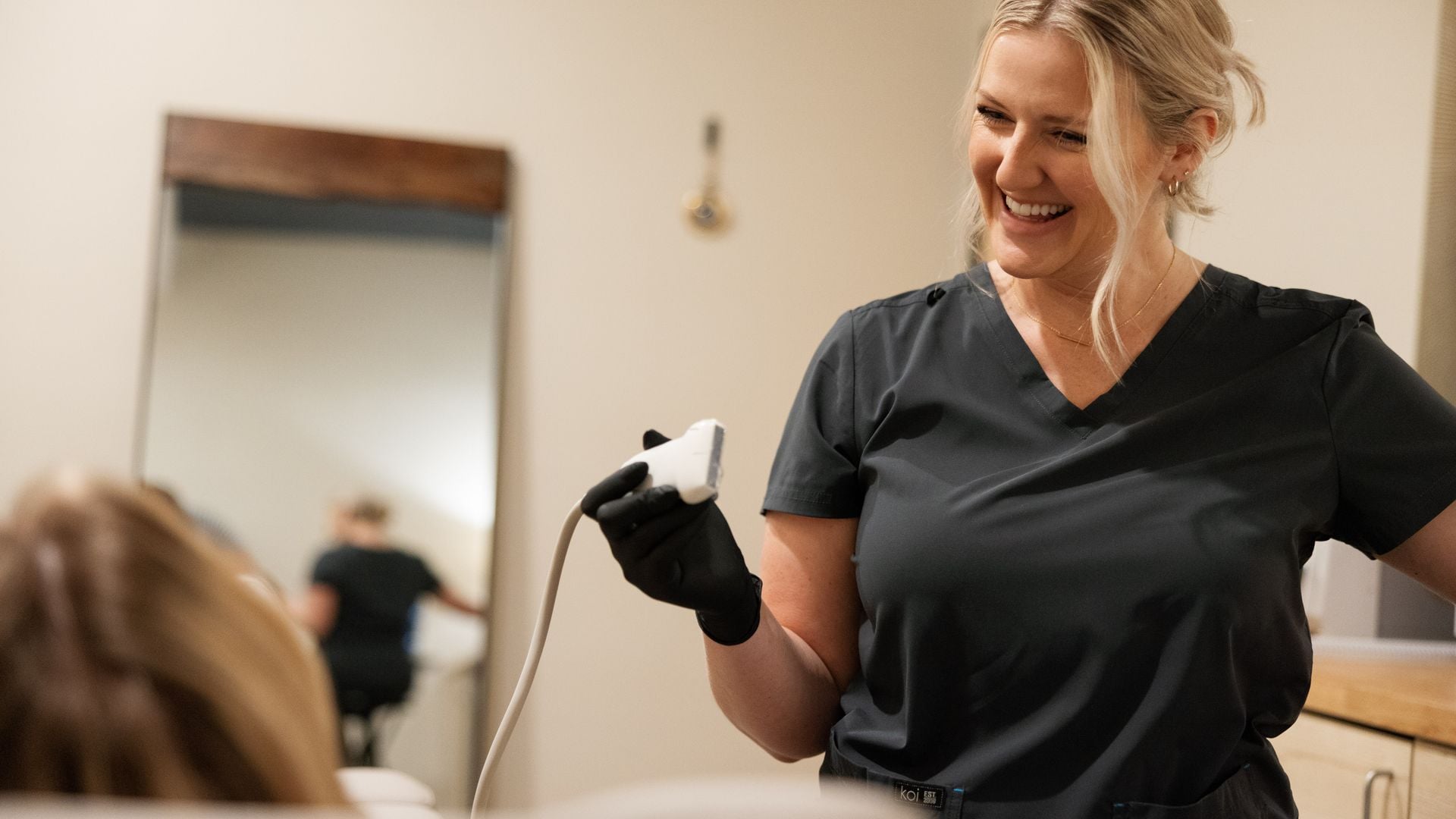
Our Vascular Screening is a bundle of two ultrasound studies done in one visit: a carotid duplex study of the neck arteries, with carotid intima-media thickness (CIMT), and an abdominal aortic aneurysm (AAA) ultrasound of the main artery in the belly. On our booking calendar the visit takes about 60 minutes. Both parts use sound waves and Doppler, with no radiation and no needles.
This article explains what each measurement is, how radiologists generally describe the results, and what the U.S. Preventive Services Task Force (USPSTF) says about scanning people without symptoms. The Task Force positions on these two arteries are different from each other, and we state them plainly below, because anyone considering a vascular screening deserves to know them before booking.
Our roles never change: our sonographer performs the scan, a board-certified radiologist reads the images and writes the report, and your own physician interprets that report for you in the context of your history, blood pressure, cholesterol, other tests and symptoms. We never diagnose, and this article does not tell you what your own result means.
Emergencies first: stroke and aneurysm warning signs
A scheduled scan is never the right response to these symptoms. If you or someone near you has any of them, call 911 immediately, even if the symptoms go away. Many hospitals teach the BE FAST acronym for stroke:
| Letter | Sign |
|---|---|
| B: Balance | Sudden loss of balance or coordination |
| E: Eyes | Sudden blurred or double vision, or loss of vision in one or both eyes |
| F: Face | One side of the face droops or feels numb; the smile is uneven |
| A: Arm | One arm is weak or numb and drifts down when both are raised |
| S: Speech | Slurred or strange speech, or trouble understanding or speaking |
| T: Time | Call 911 right away and note the time the symptoms started |
Symptoms that come and go, sometimes called a transient ischemic attack or “mini-stroke,” are also an emergency. Do not wait to see whether they return, and do not book an ultrasound instead of calling 911.
A ruptured or leaking abdominal aortic aneurysm is also a 911 emergency. Mayo Clinic lists the warning signs as sudden, severe pain in the belly or back that may feel like tearing or ripping, along with a fast pulse and low blood pressure. Feeling faint or passing out with that kind of pain is another reason to call 911 at once. Do not drive yourself.
What the Vascular Screening includes
| Part | What is imaged | What the report generally describes | Prep |
|---|---|---|---|
| Carotid duplex with CIMT | The carotid arteries on both sides of the neck | Plaque, narrowing (stenosis), blood flow velocities, and the thickness of the artery wall’s inner layers | None |
| AAA ultrasound | The abdominal aorta, the main artery in the belly | The aorta’s maximum diameter and its shape | Nothing to eat for 8 hours; water and regular medications are fine |
The carotid study: plaque and stenosis
The carotid arteries run up each side of the neck and carry blood to the brain. A carotid duplex study combines a grayscale picture of the artery wall with Doppler measurements of how fast blood is moving. Plaque is a build-up in the artery wall, and radiologists describe where it is, roughly how much there is and sometimes its texture. When an artery narrows, blood speeds up as it passes through, much like water through a pinched hose, and those faster velocities are how ultrasound estimates the degree of narrowing.
Many U.S. vascular labs grade narrowing of the internal carotid artery using categories from a Society of Radiologists in Ultrasound consensus conference. The table shows the broad categories in general terms:
| Category on a report | What it describes in general |
|---|---|
| Normal / no stenosis | No visible plaque and normal velocities |
| Less than 50% | Plaque or wall thickening with velocities below the consensus threshold (peak systolic velocity under 125 cm/s) |
| 50% to 69% | Moderate narrowing estimated from higher velocities (roughly 125 to 230 cm/s) |
| 70% or greater, short of near occlusion | Severe narrowing estimated from very high velocities (above 230 cm/s) |
| Near occlusion | A very tight narrowing where velocities can paradoxically be low |
| Occlusion | No detectable flow in the artery |
These categories are estimates, and they are one input among many. Doctors often confirm a significant result with other imaging such as CT or MR angiography, and decisions depend heavily on whether the person has had symptoms. Your physician will put any carotid finding in context with your history, blood pressure, cholesterol and other risk factors. Our article Carotid ultrasound: CIMT, plaque and stenosis explains these terms further.
CIMT: what it measures and where experts disagree
Carotid intima-media thickness (CIMT) is the combined thickness of the two inner layers of the carotid artery wall, measured in fractions of a millimeter. Thicker measurements are associated, on average, with higher cardiovascular risk in large population studies. A 2008 consensus statement from the American Society of Echocardiography concluded that carotid plaque detection and CIMT measurement can be useful for refining cardiovascular risk assessment in some patients without symptoms, when done with careful technique.
Other expert groups are more cautious. The 2013 American College of Cardiology and American Heart Association guideline on cardiovascular risk assessment states that CIMT is not recommended for routine measurement in clinical practice for assessing the risk of a first cardiovascular event. In plain terms, experts disagree about how much a CIMT number adds for an individual, and it is not a standard part of routine check-ups. If you are thinking about CIMT, ask your doctor whether it would change anything they would do for you. Your physician is the right person to interpret a CIMT measurement, alongside your other risk factors.
The aorta: diameter and what guidelines describe
The AAA part of the bundle measures the abdominal aorta’s widest diameter. An abdominal aortic aneurysm is typically defined as a diameter of 3.0 cm or larger. Aneurysms usually grow slowly and often cause no symptoms until they are large, which is why screening is discussed at all. Smoking is the strongest risk factor; age over 65, male sex and a family history of AAA also raise risk.
For physicians managing a known aneurysm, the Society for Vascular Surgery (SVS) 2018 guideline describes surveillance intervals by size, for example every three years for 3.0 to 3.9 cm, every year for 4.0 to 4.9 cm and every six months for 5.0 to 5.4 cm, and a threshold of 5.5 cm for considering elective repair in patients at acceptable surgical risk, with a lower threshold suggested for women. These are guidelines for doctors, not rules for any one person. Your doctor, often with a vascular specialist, decides what a measurement means for you. More detail is in AAA screening ultrasound.
What the USPSTF recommends, stated plainly
| Group | USPSTF position | Grade |
|---|---|---|
| Men aged 65 to 75 who have ever smoked (100 or more cigarettes) | Recommends one-time AAA screening with ultrasound | B (2019) |
| Men aged 65 to 75 who have never smoked | Clinicians should selectively offer AAA screening rather than screen all men | C (2019) |
| Women aged 65 to 75 who have ever smoked or have a family history of AAA | Evidence is insufficient to assess benefits and harms of AAA screening | I (2019) |
| Women who have never smoked and have no family history of AAA | Recommends against routine AAA screening | D (2019) |
| Adults without symptoms of stroke, mini-stroke or other carotid-related neurologic symptoms | Recommends against screening for carotid artery stenosis | D (reaffirmed 2021) |
For carotid screening, the Task Force explained that significant narrowing is uncommon in the general population, so screening produces many false-positive results; that confirming tests and procedures to open or remove plaque carry risks of stroke and death; and that the benefit of those procedures over modern medical therapy in people without symptoms is small at best. Some professional societies, including the Society for Vascular Surgery, recommend AAA screening for a broader group than the USPSTF does, such as men and women aged 65 to 75 with a history of tobacco use. Your doctor can explain how these positions apply to you.
A wellness vascular scan is your choice. It is not a test that has been shown to prevent stroke or save lives in people without symptoms, and we will not claim that it does. Talk with your doctor before booking.
Incidental findings and the limits of the scan
Any scan can turn up something unrelated to why it was done. On a carotid study, the edge of the thyroid gland sits next to the arteries, and a radiologist may note a thyroid nodule. On an aorta study, parts of the kidneys or other organs may come into view. These incidental findings are often harmless, but some lead to more scans, specialist visits or procedures. A mild finding, such as a small amount of plaque, can also cause worry or prompt further tests without changing what anyone would do. Think about how you would want to handle that, and discuss it with your doctor in advance.
It also helps to know what this bundle does not do:
- It does not look at the heart or the coronary arteries.
- It does not measure blood pressure, cholesterol or blood sugar; those come from your doctor and blood tests. We do not draw blood.
- It cannot predict whether any one person will have a stroke or aneurysm.
- It is not a check for blood clots in the veins. A DVT (vein clot) study is a separate exam that requires a referral.
Who chooses this bundle
People who book the Vascular Screening usually fall into a few groups: people whose doctor has suggested AAA screening or a carotid study, people monitoring a known aneurysm at their doctor’s request, and people who have talked with their doctor about their family history or risk factors and decided they want a baseline, understanding the trade-offs above. If your doctor has asked for only one of these studies, book that one; both are available separately. Our article Wellness ultrasound packages compares our bundles, including the Complete Longevity bundle (neck arteries, aorta, belly, thyroid, plus prostate or pelvic).
How to prepare
Because the bundle includes the aorta, have nothing to eat for 8 hours before your visit. Water and your regular medications are fine. Fasting reduces gas in the bowel, which can block the view of the aorta. The carotid part needs no prep, though an open neckline makes it easier. If you manage diabetes, ask the doctor who manages it how to handle your medication while fasting. See How to prepare for an ultrasound for prep across all our studies.
Questions to ask your doctor
- Do I fall into a group the USPSTF or another society recommends for AAA screening?
- Would a carotid study or CIMT measurement change anything you would recommend for me?
- If the report shows mild plaque or a slightly wider aorta, how would we decide what to do next?
- Should any finding be confirmed with another test, and who would I see?
- Should this scan become a baseline to compare against later?
How booking works
You book the Vascular Screening online on our booking page; no referral is needed for carotid or AAA studies. The booking form asks for the name of the doctor who should receive the report (type “None” if you do not have one) and offers an optional referral upload. Payment is a flat rate paid when you book, with no facility fee, and HSA/FSA cards are accepted. You can come to our clinic, or we bring the scan to you at home in our California service areas.
Our sonographer will not give results during the visit; our article Why won’t the sonographer tell me what they see? explains why. A board-certified radiologist reads every study; the report is ready within 24 hours and is sent to you and, if named, your doctor. Your physician then goes through it with you. What does my ultrasound report mean? explains how a report is organized.
Getting a scan with us: our vascular ultrasound page explains what the scan covers and how to prepare. You can book online for our clinic, or we bring the scan to you at home. A board-certified radiologist reads every study, and the report is ready within 24 hours. Your own doctor interprets the results for you.
Sources
- U.S. Preventive Services Task Force. Abdominal Aortic Aneurysm: Screening (2019)
- U.S. Preventive Services Task Force. Asymptomatic Carotid Artery Stenosis: Screening (2021)
- Chaikof EL et al. The Society for Vascular Surgery practice guidelines on the care of patients with an abdominal aortic aneurysm. J Vasc Surg, 2018
- Society of Radiologists in Ultrasound consensus on carotid stenosis thresholds (Grant EG et al., Radiology, 2003), summary
- Stein JH et al. Use of Carotid Ultrasound to Identify Subclinical Vascular Disease and Evaluate Cardiovascular Disease Risk. American Society of Echocardiography, 2008
- American College of Cardiology. 2013 ACC/AHA Guideline on the Assessment of Cardiovascular Risk, summary
- Mayo Clinic. Abdominal aortic aneurysm: symptoms and causes
- Duke Health. Know the signs of stroke: BE FAST
Frequently asked questions
What does the Vascular Screening include?
It combines a carotid duplex study of both neck arteries, including carotid intima-media thickness (CIMT), with an abdominal aortic aneurysm (AAA) ultrasound of the main artery in the belly. The visit takes about 60 minutes, and a board-certified radiologist reads both studies.
Does the USPSTF recommend carotid or AAA screening?
The USPSTF recommends one-time AAA ultrasound screening for men aged 65 to 75 who have ever smoked (grade B) and selective screening for men in that age group who have never smoked (grade C). It recommends against routine AAA screening in women who have never smoked and have no family history (grade D). It recommends against carotid artery stenosis screening in adults without symptoms (grade D). Talk with your doctor before booking.
Do I need to fast for the Vascular Screening?
Yes, for the aorta part. Have nothing to eat for 8 hours before the visit; water and your regular medications are fine. The carotid part needs no prep. If you manage diabetes, ask the doctor who manages it how to handle your medication while fasting.
What is CIMT and is it useful?
CIMT is the thickness of the inner layers of the carotid artery wall. A 2008 American Society of Echocardiography consensus said it can help refine risk assessment in some people without symptoms, while the 2013 ACC/AHA risk guideline does not recommend it for routine use. Ask your doctor whether it would change anything for you.
Can a vascular ultrasound tell me if I will have a stroke?
No. It describes plaque, narrowing, wall thickness and the aorta’s diameter, but it cannot predict whether any one person will have a stroke or aneurysm, and it is not shown to prevent stroke in people without symptoms. Your doctor interprets the report with your other risk factors.
What should I do if I have stroke symptoms?
Call 911 immediately. Use BE FAST: sudden loss of balance, vision changes, facial droop, arm weakness, or speech trouble, and note the time symptoms started. Call 911 even if symptoms go away. Sudden severe belly or back pain that feels like tearing is also a 911 emergency. Do not book a scan instead.
This article is general health information, not medical advice. It does not replace a conversation with your own physician, who knows your history and can interpret results in context. If you have symptoms that worry you, contact your doctor; if you think you are having a medical emergency, call 911.